Essay
When Both Side Pillars Are Compromised, Only the Middle Remains
When both the overt axis of power and the supposedly higher axis of grace can be captured, integrity can no longer rely on choosing the better side. It has to move vertically.

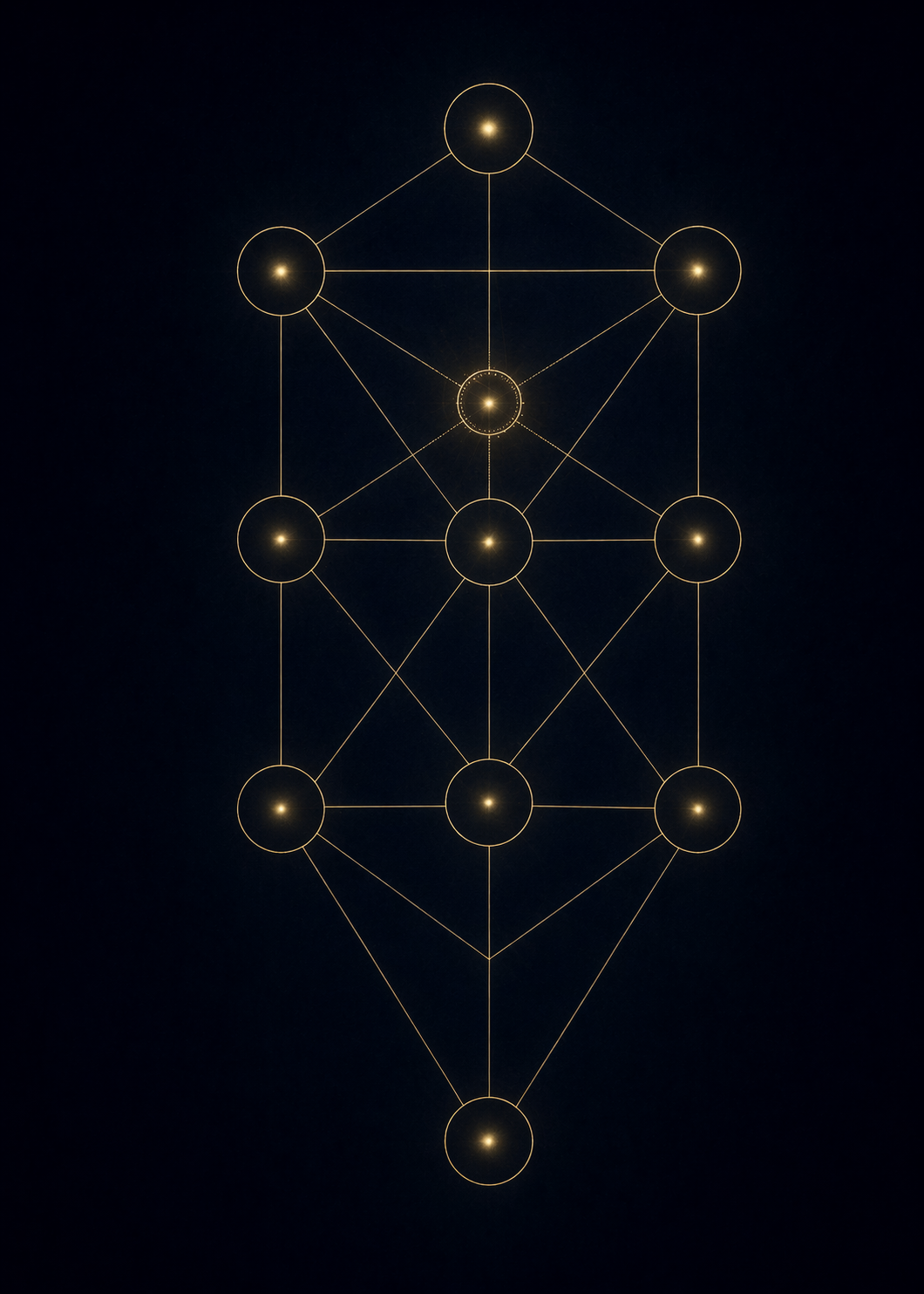
One of the most destabilizing realizations in any serious path is that corruption does not only live where it is obvious.
At first the map seems simple. One side represents overt power, management, hierarchy, domination, the cold mechanics of keeping things in place. The other side appears to offer the corrective. Grace, refinement, order, elevated tradition, the language of light, the promise that there is a cleaner authority somewhere above the crude machinery of control.
This opposition is reassuring for a while. It allows a person to believe that when one side becomes visibly compromised, the answer is simply to move to the other. If the harsh pillar of structure becomes parasitic, then perhaps the pillar of spirit remains trustworthy. If the world of control is corrupt, then perhaps the world of refinement remains pure.
But there is a deeper correction to make here. The side pillars were never ultimate in the first place. Even at their best they were partial expressions, not final ground. That means side choosing may sometimes be practically necessary, but it was never sufficient in any final sense.
And once this becomes visible, the confidence that one side can save you from the distortions of the other does not survive contact with reality for long.
When the right hand is also captured
There comes a point where even the refined forms begin to look instrumented. The symbols still glow. The language is still elevated. The order still appears graceful. But the deeper one looks, the more it becomes clear that what appears as light is not automatically free of use, appropriation, or system function.
This is the more serious disillusionment.
Most people are already prepared for the possibility that open power is corrupt. Fewer are prepared for the possibility that what presents itself as healing, tradition, mercy, or refinement can also be drafted into the same logic. The result is not only disappointment. It is orientation collapse.
Because once both side pillars can be captured, the usual strategy fails. The question is no longer which side is cleaner. The question becomes whether side taking itself has become part of the trap.
What capture actually means
Capture does not always mean the same thing. Sometimes it is structural. A system begins with a genuine function and slowly reshapes itself around survival, status, or institutional continuity until what once served truth now serves self preservation. Sometimes it is intentional. Actors within the structure learn how to instrumentalize its symbols, language, or trust for power. Sometimes it is epistemic. The form itself may remain partially clean, but the seeker’s relation to it becomes distorted through projection, idealization, or dependency.
These forms of capture often overlap. A political movement can be structurally captured by incentives, intentionally captured by opportunists, and epistemically captured in the mind of the believer all at once. The same is true of spiritual systems. What matters here is not proving that every structure is equally corrupt, or that every tradition was false from the beginning. What matters is recognizing that no side pillar is protected in principle from capture merely because its self description is noble. A pillar may carry a real partial truth and still become dangerous once that partial truth is treated as sufficient.
The collapse of horizontal trust
As long as one still believes that one side of the structure remains reliable, integrity can remain horizontal. One can choose the better institution, the better order, the better doctrine, the better camp. One still moves laterally across the field of visible alternatives.
But when both side pillars are compromised, horizontal movement loses its force. The field is no longer a set of meaningful opposites. It is a managed range of apparent alternatives whose function may be to keep the seeker moving sideways forever.
A familiar example is the political field itself. One party openly manages, disciplines, and coerces. The other wraps the same dependence in the language of care, intelligence, or refinement. The styles differ. The mechanisms are often closer than they appear. At first the seeker chooses the cleaner side. Later they begin to realize that choosing sides inside a managed field may only deepen their dependence on it.
This is where the middle pillar stops being a mystical extra and becomes a practical necessity.
The middle is not simply balance between corrupted poles. It is not the diplomatic refusal to choose. It is not moderation for its own sake. It is the abandonment of the assumption that integrity can still be found by choosing the correct side within a captured structure.
At that point only vertical orientation remains.
What the middle pillar actually is
The middle pillar is not a compromise between power and grace. It is a different axis entirely.
Its logic is not managerial and not ornamental. It does not ask which side appears more legitimate. It asks what remains true when legitimacy itself has become unstable. In positive terms, the middle pillar is direct alignment with reality through unborrowed contact. It is the attempt to relate to what is real without needing that relation to be certified by side membership, institutional prestige, or inherited symbolism.
This is why the middle pillar is so easy to misunderstand. It is often described as the place of balance, but that can make it sound soft, centrist, or vague. In reality the middle pillar becomes relevant only when simple balance is no longer enough. It matters most when both sides have become unreliable and the entire horizontal field has to be pierced rather than navigated.
The middle does not solve the corruption of the side pillars by arranging them more elegantly. It stops asking them for permission.
Why Da’at matters here
This is where Da’at becomes decisive.
Da’at is often translated as knowledge, but here that word is too weak. It is not information. It is not accumulation. It is the rupture that occurs when the seeker’s dependence on managed alternatives breaks down. It is the moment when comparison itself no longer feels sufficient, not because one has found a nicer option, but because the whole method of lateral trust has become suspect.
That rupture is not abstract. Subjectively it often feels like a double loss. The coarse system can no longer be trusted, but neither can the refined one. The ego loses not only its enemies but also its preferred refuge. That is why this threshold can resemble paralysis, cynicism, or nihilism before it becomes orientation. Something has to die there, specifically the hope that a clean identity can still be built by affiliating with the right side.
Da’at is what names that threshold crossing. Not because it explains away the experience, but because it marks the point where managed alternatives cease to organize the seeker’s loyalty. Genuine crossing cannot be recognized by language alone. It has to show up as a changed relation to authority, less hunger for certification, less seduction by symbolic glamour, more willingness to remain unbacked while staying exact.
The narrowness of the only remaining path
If both side pillars are compromised, then the middle pillar is not merely preferable. It becomes the only workable axis of integrity.
This is a practical claim, not a metaphysical proof. It means that once the visible field of alternatives has become unreliable enough, a person who still wants to remain aligned has to shift their basis of trust. Not because the middle is immune by magic, but because borrowed legitimacy has failed and direct contact is all that remains workable.
Not because it is safer. It is not. Not because it is socially legible. It is not. Not because it offers more comfort than the captured alternatives. It offers less.
The middle pillar is narrow because it cannot borrow legitimacy from either side. It has to stand by direct alignment alone. That means less institutional reassurance, less symbolic glamour, less protection from uncertainty. It also means less dependency on compromised structures for one’s sense of orientation.
This is the shift from managed belonging to vertical contact.
The person on the middle pillar is no longer asking which order looks most trustworthy. They are asking what remains true when trust in orders has broken down. They are no longer trying to identify the least contaminated side. They are trying to remain aligned with what is not available for contamination in the same way.
What this looks like in practice
The middle pillar cannot remain a mood. It has to become a discipline.
In practice this means several things. It means refusing premature allegiance when a structure asks for trust it has not earned. It means pausing before symbolic seduction, especially when a system flatters the part of you that wants to be among the knowing. It means staying with the discomfort of not yet knowing where to stand instead of resolving the uncertainty by adopting the cleanest available banner. It means asking not which side sounds best, but what actual contact with reality increases or decreases when I move closer to it.
It also has a collective dimension. The middle pillar is not solitary purity. If it were, it would collapse into elegant withdrawal. The real test is whether people can form relation, cooperation, and shared work without rebuilding the same horizontal capture under a more spiritual name. This requires self reliance without bitterness, seriousness without theatrics, and the capacity to build with others while remaining unavailable for idolization.
That cost is real. You lose the reassurance of camps. You lose the emotional ease of righteous belonging. You may lose the sympathy of both sides. But what you gain is the possibility of relation that is not entirely mediated by capture.
Why this matters now
This pattern matters because more and more domains show the same failure mode. Political structures are compromised in obvious ways. Spiritual language is increasingly aestheticized, platformed, and instrumentalized. Alternative systems often become mirrors of the systems they claim to escape. The left hand can be corrupted by force. The right hand can be corrupted by sanctimony. Both can be folded back into the same machine.
Under those conditions, integrity can no longer be a matter of taste or allegiance. It has to become a matter of vertical seriousness.
That does not mean abandoning discernment between side pillars entirely. It means refusing to mistake relative cleanliness for ultimate trustworthiness. It means understanding that there are moments when choosing the better side is still practically necessary, while also seeing that it was never sufficient at the deepest level.
The deeper work begins where side loyalty ends.
If you want the frame behind this argument, the previous essay, The Three Pillars of Western Esotericism, lays out the larger structure this piece is building on.
The workable thesis
If both side pillars are compromised, only the middle remains as a workable axis of integrity.
Not the safest institution. Not the most beautiful order. Not the side with the most elevated symbols. The middle remains because it is the only line that does not depend for its legitimacy on the horizontal field of alternatives once that field has become unreliable enough to trap the seeker rather than orient them.
That is the function of the vertical line. Not superiority. Orientation.
And when both sides glow with partial truth and partial corruption, orientation is worth more than comfort.
If this resonated, there are other parts of the structure you can explore.
You can begin at the entry point:
Start here
Or continue along nearby threads:
I Am the Formula ·
The Void ·
Truth ·
Essays
Link to this page
https://fractalisme.nl/when-both-side-pillars-are-compromised-only-the-middle-remains