Fractalism
Community
On why community is one of the hardest tests of whether Fractalism can become more than thought.

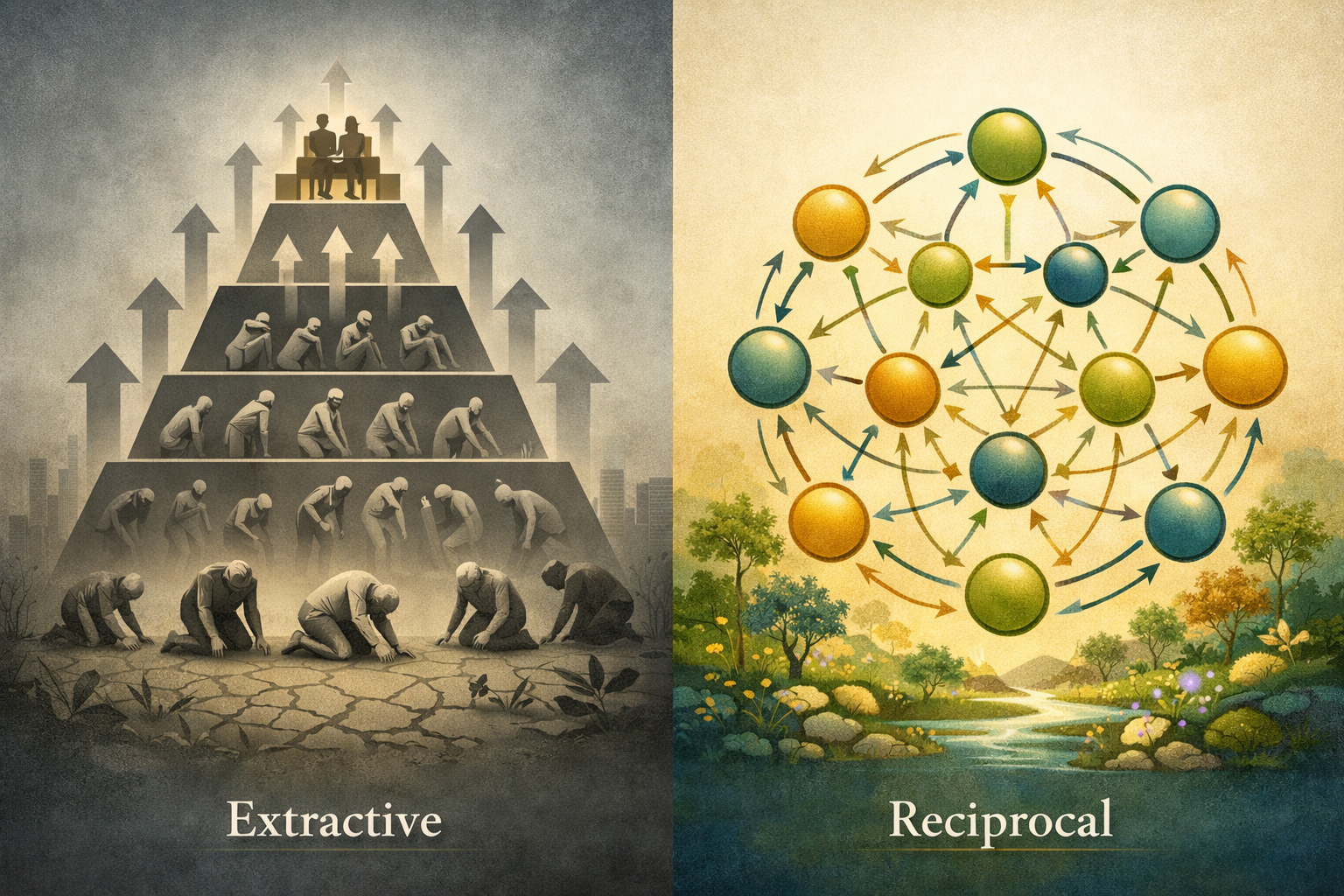
If Fractalism ever takes social form, that movement will need far more caution than enthusiasm.
This page does not announce an existing community. It names a problem.
Fractalism does not yet know whether a human field can be built around truth, reciprocity, sobriety, correction, and real responsibility without quickly reproducing performance, dependency, manipulation, status play, or disguised control.
That uncertainty should remain part of the question.
Why the question matters
Modern life makes community sound easier than it is. People are connected all the time, but often remain lonely, unrecognized, and structurally unsupported. Communication increases while trust weakens. Belonging gets replaced by image, transaction, audience, and managed identity.
If Fractalism is serious, it cannot remain only a philosophy. If truth matters, it eventually has to become visible in relation.
But social form is also one of the most dangerous places a framework can go wrong. Community is one of the places where a project either begins to take life, or begins to corrupt itself.
What this page is not claiming
This page does not describe a formed Fractalism community. It does not claim that such a field already exists. It does not sort people into the worthy and unworthy.
It asks what would have to become true for community not to decay immediately into something false.
A serious community does not come into being because people repeat the same vocabulary. It is not a cult. It is not a personality structure. It is not a refuge for spiritual theater. It is not a network built around subtle guilt, hidden extraction, or elevated language masking ordinary appetite.
Why community attempts so often fail
The real difficulty is not only bad intention. It is that human beings bring hunger, fear, projection, shame, dependency, idealization, loneliness, and status sensitivity into shared life.
That means even a sincere attempt can decay quickly. Belonging can become dependency. Care can become control. Truth can become aggression. Correction can become humiliation. Goodness can become image. Structure can become hidden hierarchy.
The desire to build honest community can itself become moral ambition, self-importance, or spiritual theater. The wish to belong can become a way of avoiding solitude. The wish to lead can become a way of hiding hunger. The wish to protect the field can become emotional management.
That danger belongs not only to participants, but also to the person proposing the question in the first place. The desire to build something clean can itself become vanity, control, or spiritualized longing.
What would actually have to be true
Without some real capacities, any attempt at community would likely collapse.
It would need accountable structure rather than hidden power. It would need honesty that is safer than image. It would need correction that does not become humiliation. It would need belonging that does not become dependency. It would need enough sobriety that the field is not constantly clouded by compulsion, intoxication, performance, or avoidance.
These are not entry requirements by which people should be sorted into the pure and impure. They are difficulties any attempt at community would have to face.
How failure would have to be recognized
A group should not be judged mainly by how sincere its language sounds, but by what it actually produces in the people inside it.
Do people become more honest or more careful with image? More capable of correction or more brittle? Less dependent or more subtly managed? More able to disagree without fear, or more likely to self-censor?
Signs that an attempted community is going wrong include:
- disagreement becomes threat
- correction becomes status theater
- belonging becomes dependency
- the founder becomes hard to challenge
- language becomes cleaner while people become less free
- warmth disappears and only moral seriousness remains
- people become more strategic, not more honest
Even a small circle can fail in these ways. That failure should be legible rather than hidden behind beautiful language.
Structure without domination
A healthy community does not require the fantasy of no structure. It requires accountable structure.
There will still be role differentiation, competence, temporary coordination, delegated responsibility, and boundaries. The point is not to erase all asymmetry. The point is to prevent power from becoming unaccountable, mystical, or protected from correction.
Otherwise hidden hierarchy simply replaces visible hierarchy, and becomes harder to challenge.
Small before large
Fractalism has no interest in scale for its own sake.
If there is any future here, it will probably begin in small, sober, high trust circles. Large systems tend to decay when they grow faster than integrity, discernment, and relational capacity can support.
But small before large does not mean permanently hypothetical. Even a small circle would have to remain testable by what it actually produces in the lives and relations of the people inside it.
The right question is not how to grow as fast as possible. The right question is whether anything clean enough to become worth growing can remain honest under pressure.
Closing
Community is one of the hardest tests of whether Fractalism means anything beyond thought.
Not because it offers automatic belonging, but because it exposes whether truth, reciprocity, sobriety, and correction can survive actual relation without decaying into performance, control, or moral theater.
It is still unclear whether such a field can be built without reproducing the distortions it is trying to refuse.
That uncertainty should not be edited out. It belongs to the truth of the question.
Where We Gather
Fractalism operates across two primary digital spaces, each serving a different functional purpose in the removal of distortion.
1. The Oubliette Refugee Forum (Nostr)
The Public Signal. This is our decentralized broadcast layer. It is un-erasable, censorship-resistant, and owned by no one. Use this to follow dispatches from the operator and participate in the public discourse.
- Follow the Signal: Nostr Escape Route
- The Live Feed: The Oubliette Forum
2. The Alchemical Lab (Discord)
The Liquid Gnosis. This is our real-time environment for field-work, direct friction, and the refinement of new language. It is a space for “conscious participants” rather than consumers. If you are looking for entertainment, you will find it cold. If you are looking to sharpen your resolution, the door is open.
- Join the Lab: Discord Server
Link to this page
https://fractalisme.nl/community