Architecture
The Structure of Fractalism
A readable overview of how Fractalism moves from truth and distortion, through lived experience and moral orientation, into social form.

Fractalism is easier to understand when its ideas are seen as parts of a single structure.
It is not a pile of separate concepts. It is an attempt to show how certain patterns repeat across inner life, lived experience, ethics, and collective form.
Its core intuition is simple. What appears in a person can later appear in a relationship, a group, an institution, or a culture. The pattern changes form, but the underlying structure can remain recognisable.
That is why Fractalism needs structure. Without it, the framework can feel diffuse. With it, the ideas become easier to place, test, and use.
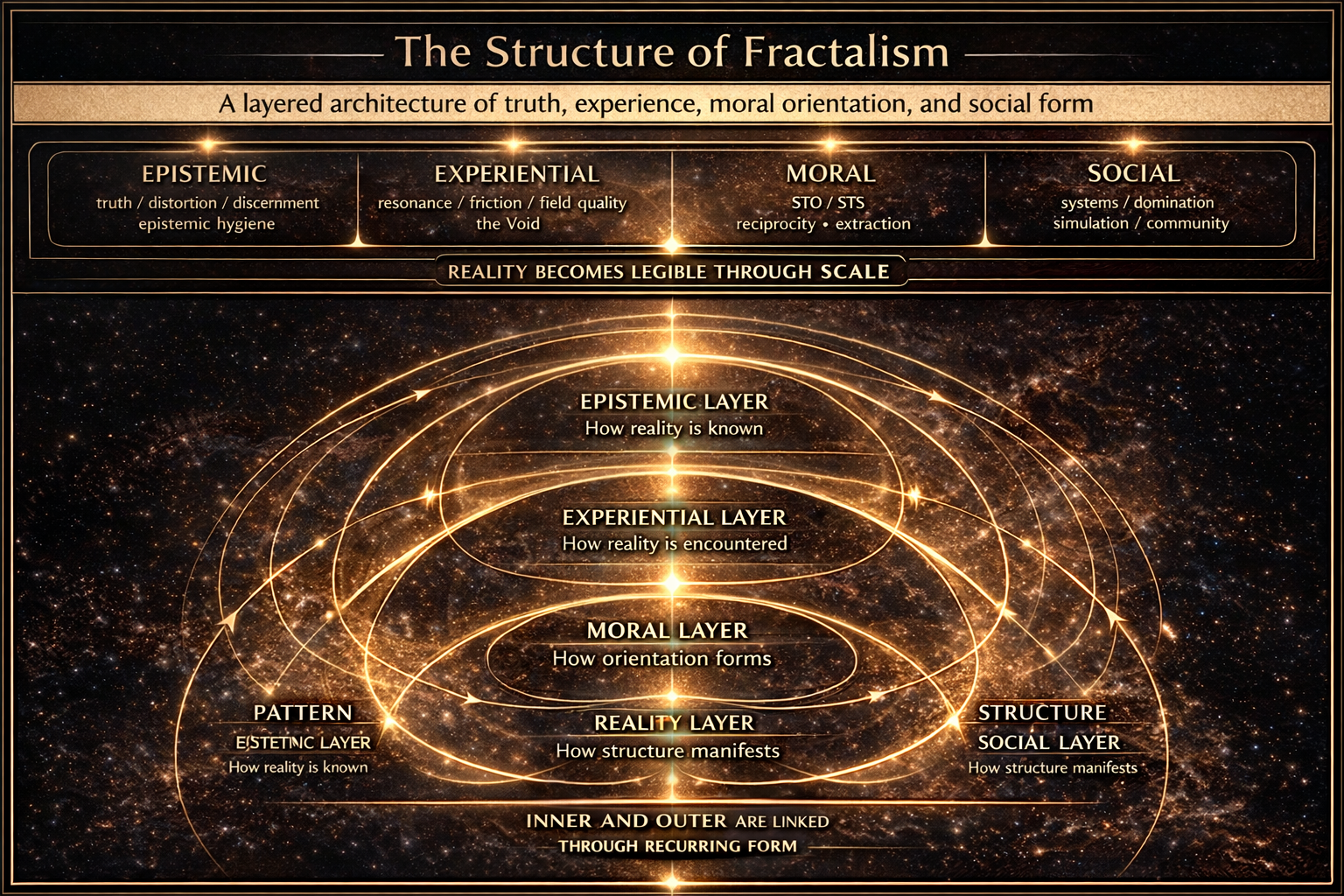
The epistemic layer
The first layer asks a basic question: what is real, and how do we notice when we are misreading it?
This is where Fractalism places truth, distortion, discernment, and epistemic hygiene. It is the layer concerned with clarity. Not certainty in the arrogant sense, but better contact with what is actually there.
At this level, the framework asks whether perception is being sharpened or bent. It asks whether language is clarifying reality or covering it over. It asks whether a symbol is being used carefully, or inflated into a claim it cannot carry.
This matters because every other layer depends on it. If you cannot tell the difference between insight and projection, the rest of the system becomes unstable very quickly.
The experiential layer
The second layer asks how reality is actually encountered in lived experience.
This is where Fractalism places resonance, friction, field quality, and the Void. These are not there to create atmosphere. They are there because truth and distortion are not only abstract ideas. They are felt in the body, in speech, in rooms, in pauses, in the way attention sharpens or collapses.
A field can leave you clearer or more fragmented. Friction can point to misalignment, or it can appear when an old pattern is resisting necessary correction. The Void is the brief interval in which a person may notice the pattern beginning before reflex fully hardens into action.
This layer matters because a framework that cannot be lived will eventually become decorative.
The moral layer
The third layer asks what direction a person, relation, or system is actually moving in.
This is where Fractalism places reciprocity and extraction, responsibility and evasion, and the broader distinction between mutual relation and instrumental relation.
At this level, the framework stops being neutral description. Patterns are no longer only things to notice. They also begin to shape what kind of relation a life is producing.
So the question becomes: what is being served? Is relation becoming more mutual or more instrumental? Is truth being honored or used selectively? Is a person making more room for reality, or reducing everything to the needs of the isolated self?
This is also where Fractalism begins to approach what might be called inverse gnosis: the use of intelligence, symbolism, or psychological insight in the direction of control, fixation, or extraction rather than clarification. That possibility matters because a framework can become more sophisticated while becoming less true.
This matters because discernment is never only intellectual. It has ethical weight.
The social layer
The fourth layer asks what kind of world these patterns build when they become collective.
What begins inwardly does not stay inward. Repeated ways of seeing, wanting, and relating can harden into shared habits, institutional norms, and public forms of life.
At this level, Fractalism moves beyond private introspection. It asks what happens when personal distortion becomes social pattern, when attention capture becomes institutional, and when forms of extraction no longer appear only in relationships but in systems.
This is also the level at which attention capture becomes politically and culturally central. Modern power often works not only through force or law, but through the shaping of salience, distraction, and what becomes psychologically real. That is explored more directly in The Matrix as a Machine for Capturing Attention.
This is what gives the framework social relevance. It is not only trying to understand private experience. It is asking what kind of world repeated patterns create.
One example
Take a person in a draining relationship.
At the epistemic level, the question is what is actually happening, and what story is hiding it. Is the person seeing clearly, or rationalizing what they already do not want to face?
At the experiential level, the question is how the pattern is felt. What happens to attention, steadiness, and friction? What is the field quality of the relationship? Is there a moment before the familiar reaction where another response is still possible?
At the moral level, the question is what the relation is becoming. Is it moving toward reciprocity, or toward control, management, and extraction?
At the social level, the question is what wider conditions are reinforcing it. Which norms, habits, or shared distortions make this pattern easier to normalize and harder to interrupt?
The layers are different, but together they show more than any one layer can show on its own.
How the layers relate
These layers are different, but they are not separate.
The epistemic layer asks what is real and how we know.
The experiential layer asks how that reality is actually felt and encountered.
The moral layer asks what direction that encounter calls forth.
The social layer asks what kind of world those directions build over time.
Fractalism works best when these layers remain connected without being collapsed into each other. Not every experience is a truth claim. Not every truth claim is a moral judgment. Not every moral judgment is a social diagnosis. But all of them can shape one another.
Why this structure matters
Without structure, Fractalism can sound like a collection of intense words. With structure, it becomes easier to see what each concept is doing, where it belongs, and what kind of claim it is actually making.
That is what turns the framework from a mood into a usable architecture.
Closing
Fractalism is not only about seeing patterns. It is about learning which patterns belong to truth, which belong to distortion, and what kind of life and world each pattern tends to create.
Link to this page
https://fractalisme.nl/the-structure-of-fractalism