Fractalism
The Axioms of Fractalism
Fractalism is articulated through 26 axioms. Before them stands the undivided ground from which articulation becomes possible at all.


Fractalism is articulated through 26 axioms, but they are best approached as a deepening of the introduction rather than as a substitute for it.
They should not be read as unquestionable decrees. They are better understood as compact statements of the framework’s deepest assumptions, written in a style that is sometimes philosophical, sometimes symbolic, and sometimes metaphysical.
Before them stands The Ground: the undivided source from which articulation becomes possible at all. The Ground is not counted among the axioms. It is the pre-axiomatic condition from which the sequence emerges and to which it returns in completion.
The structure is simple:
- The Ground - the source before articulation
- Axioms 1-26 - the articulated body of the system
Contents
- The Ground
- Axiom 1 - The Universal Equation
- Axiom 2 - The Eternal Now
- Axiom 3 - Fractal Scaling
- Axiom 4 - The “I Am” Constant
- Axiom 5 - The Fractal Big Bounce
- Axiom 6 - The Law of Recurrence
- Axiom 7 - The Veil of Amnesia
- Axiom 8 - The Law of Fractal Deviation
- Axiom 9 - The Law of Elastic Correction
- Axiom 10 - The Arc of Return
- Axiom 11 - The Principle of Self-Correction
- Axiom 12 - The Power of Non-Linear Emergence
- Axiom 13 - The Holographic Whole
- Axiom 14 - Fractal History
- Axiom 15 - Harmonic Restoration
- Axiom 16 - Universal Echo
- Axiom 17 - Synchronicity as Signal
- Axiom 18 - Relational Consciousness
- Axiom 19 - The Primacy of Resolution
- Axiom 20 - The Feedback Loop
- Axiom 21 - The Eye of Resolution
- Axiom 22 - The Axiom of Symbiosis
- Axiom 23 - The Axiom of Social Noise
- Axiom 24 - The Law of Obstruction
- Axiom 25 - The Pure Observer
- Axiom 26 - The Omega Loop
- Axiom 27 - The Harmonic Departure
The Ground
The Ground - Pre-Axiomatic Unity
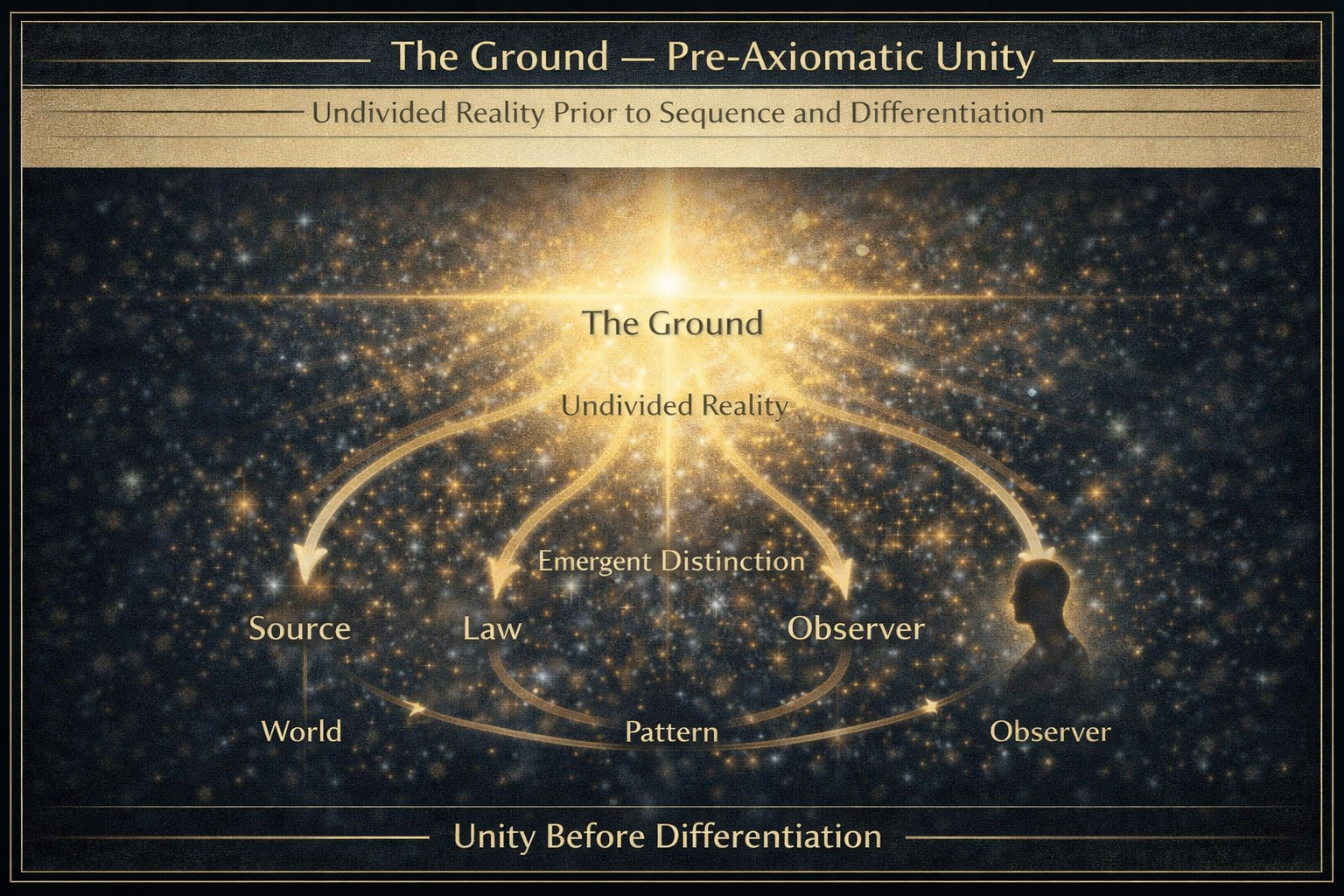
I am the formula. There is no final separation between source, law, and observer. The Ground is not the first item in a numbered list, but the undivided reality from which all later distinctions emerge. The essence of the observer is of the same nature as the Source, though not identical to the conditioned self.
Plain language
Before all distinctions, reality is one. Separation appears within experience, but is not ultimate.
Example
A person may spend years experiencing life as if they are a disconnected self moving through a dead world of separate objects. But in rare moments of deep silence, love, beauty, or direct presence, that split can soften. Reality is no longer encountered as subject over here and world over there, but as one living field in which observer and observed are not finally separate.
Why it matters
The Ground prevents Fractalism from becoming only a theory of patterns. It names the undivided source from which pattern, form, relation, and consciousness arise.
How to read the axioms
Some of these axioms are more bounded than others.
Some should be read primarily as structural claims. Others are better read as working metaphysical propositions. Others are closer to orienting language than to empirical statements in a narrow scientific sense.
That does not make them useless. It means they should be read with the same epistemic hygiene Fractalism asks of everything else.
A note on epistemic status
The axioms below vary in how they should be read. A rough map:
| # | Axiom | Type | Notes |
|---|---|---|---|
| 1 | The Universal Equation | Metaphysical | A grounding assumption, not a tested formula |
| 2 | The Eternal Now | Metaphysical | Orientation in time, not a physical claim |
| 3 | Fractal Scaling | Empirical | Most testable: pattern recurs across scales |
| 4 | The “I Am” Constant | Metaphysical | Philosophical position on consciousness |
| 5 | The Fractal Big Bounce | Metaphysical | Cosmological metaphor, not a physics claim |
| 6 | The Law of Recurrence | Empirical | Observable in psychology and systems theory |
| 7 | The Veil of Amnesia | Metaphysical | Symbolic, not verifiable |
| 8 | The Law of Fractal Deviation | Orientering | Useful framing; protects against falsification |
| 9 | The Law of Elastic Correction | Orientering | Approximates karma; vague timing and mechanism |
| 10 | The Arc of Return | Metaphysical | Poetic; describes a movement, not a fact |
| 11 | The Principle of Self-Correction | Orientering | Grounded in systems theory; useful not proven |
| 12 | Non-Linear Emergence | Empirical | Recognized in complexity theory and psychology |
| 13 | The Holographic Whole | Orientering | Metaphor with partial grounding in physics |
| 14 | Fractal History | Orientering | Pattern recognition; hard to falsify cleanly |
| 15 | Harmonic Restoration | Orientering | Recovery tendency; meaningful but not mechanical |
| 16 | Universal Echo | Metaphysical | Symbolic recurrence; unverifiable |
| 17 | Synchronicity as Signal | Orientering | Plausible; no falsification condition |
| 18 | Relational Consciousness | Empirical | Well-grounded in developmental psychology |
| 19 | The Primacy of Resolution | Orientering | Value claim; about priority, not mechanism |
| 20 | The Feedback Loop | Empirical | Strongest empirical grounding of all axioms |
| 21 | The Eye of Resolution | Orientering | Cultivated capacity; not mystical |
| 22 | The Axiom of Symbiosis | Empirical | Supported by ecology and game theory |
| 23 | The Axiom of Social Noise | Orientering | Sociological observation; hard to operationalize |
| 24 | The Law of Obstruction | Metaphysical | Structurally unfalsifiable |
| 25 | The Pure Observer | Metaphysical | Phenomenological report; not provable |
| 26 | The Omega Loop | Metaphysical | Poetic theology; return narrative |
| 27 | The Harmonic Departure | Metaphysical | The irrational leakage of the Source |
This table is not a verdict. It is a map showing where the confidence should be calibrated differently.
A note on the risks of this kind of framework
Grand narratives meet real psychological needs. They can offer coherence, direction, and a sense of meaning. They can also become refuge from uncertainty, ordinariness, and the uncomfortable work of remaining undefended in the face of not-knowing.
A framework that presents 26 compact statements about reality carries an inherent risk: the reader who is searching may find in it a totalizing system that feels like certainty. That person may use Fractalism not to see more clearly but to avoid the anxiety of remaining open to correction.
This is not an accusation. It is a structural observation. Any framework ambitious enough to speak about consciousness, pattern, and return will attract seekers who need it to be true in the way that resolves their discomfort rather than sharpens it.
The most honest thing a framework like this can do is name that tendency clearly: toward the end of these axioms, you are not reading facts. You are reading working orientations that should be tested against your own experience and held lightly enough to be revised.
The 26 Axioms
Axiom 1 - The Universal Equation
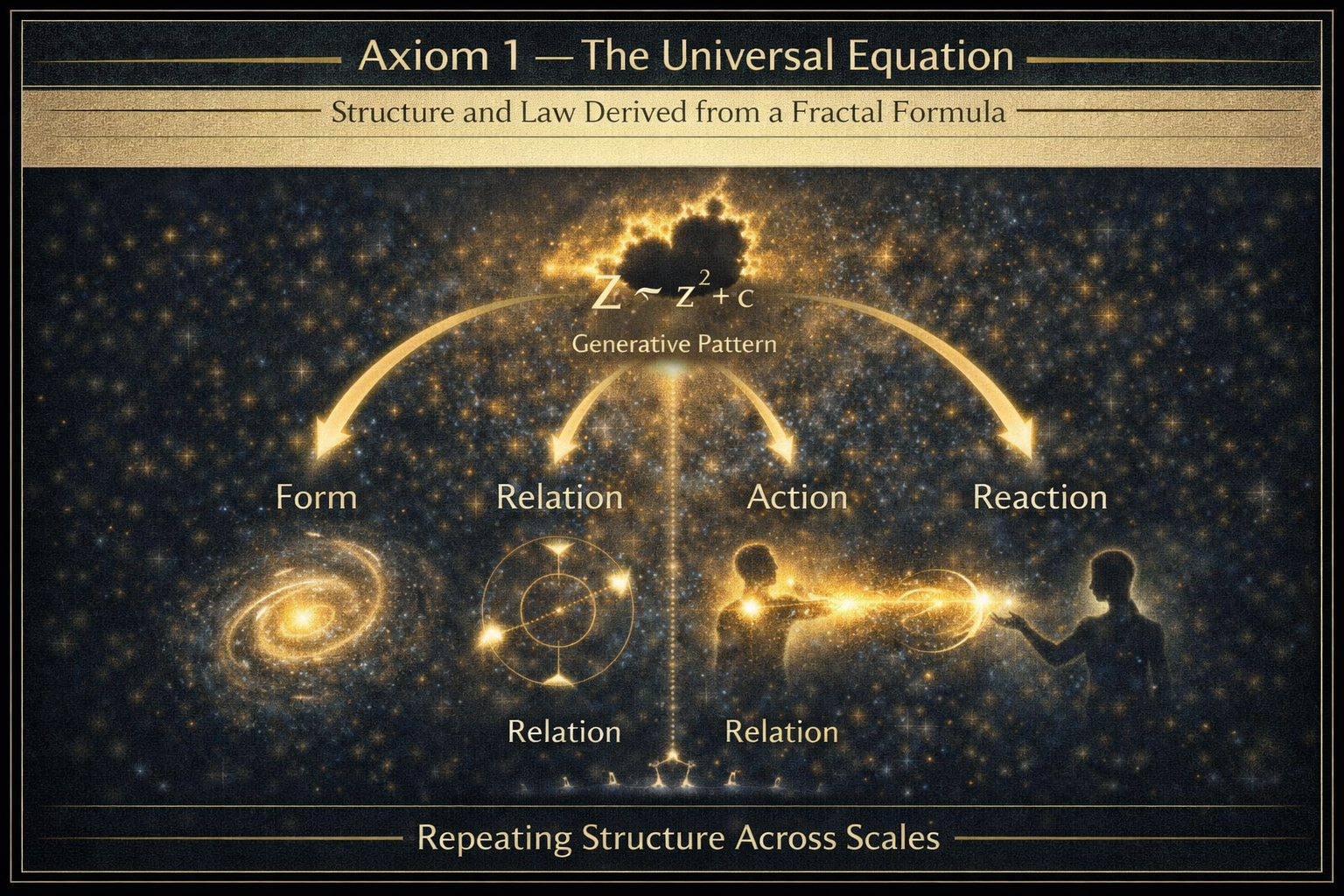
Everything is derived from the fractal formula that shapes form, relation, and the laws of action and reaction.
Plain language
Reality is not made of disconnected parts. There is an underlying order shaping how things arise and relate.
Example
A person may first interpret life as a series of unrelated events: a conflict here, a symbol there, a relationship elsewhere, a historical pattern somewhere else again. Over time, they begin to sense that these are not isolated fragments but expressions of a deeper structure. The point is not that everything becomes identical, but that reality starts to feel ordered rather than random.
Why it matters
The Universal Equation establishes Fractalism as a framework of coherence. It suggests that pattern is not accidental, but structural.
Axiom 2 - The Eternal Now
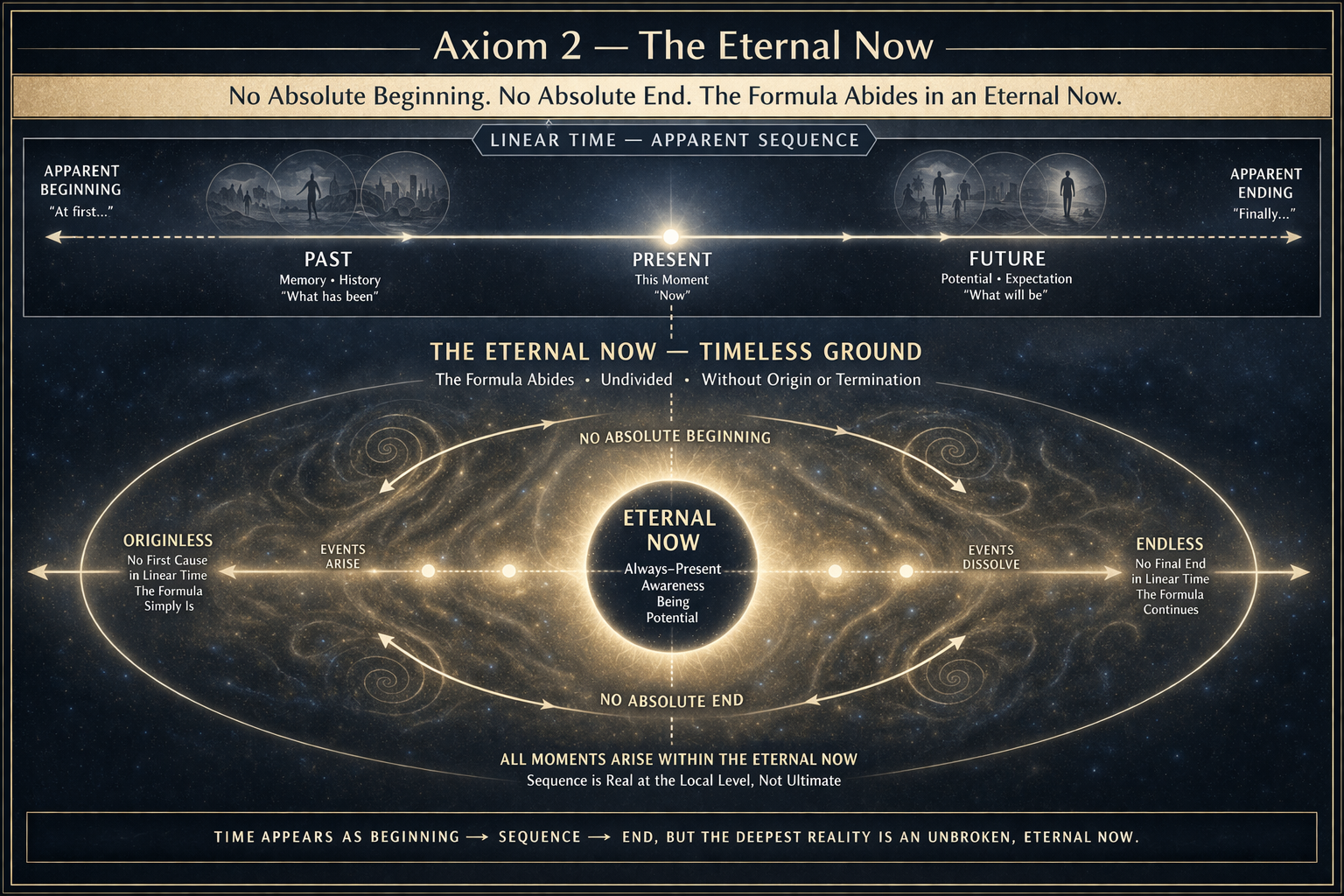
There is no absolute beginning or end. The formula abides in an eternal Now and has no final origin in linear time.
Plain language
Reality is not exhausted by the timeline through which humans usually experience it.
Example
A person may live as if meaning only exists in the future or in the past: what has been lost, what has not yet happened, what must still be achieved. But in moments of real presence, something different becomes available. The importance of the moment is no longer borrowed from before or after. The Now is no longer just a point between times, but a depth in which reality is directly encountered.
Why it matters
The Eternal Now loosens the assumption that reality is only a line moving from origin to ending. It allows Fractalism to speak about presence as ontological depth rather than mere mindfulness.
Axiom 3 - Fractal Scaling
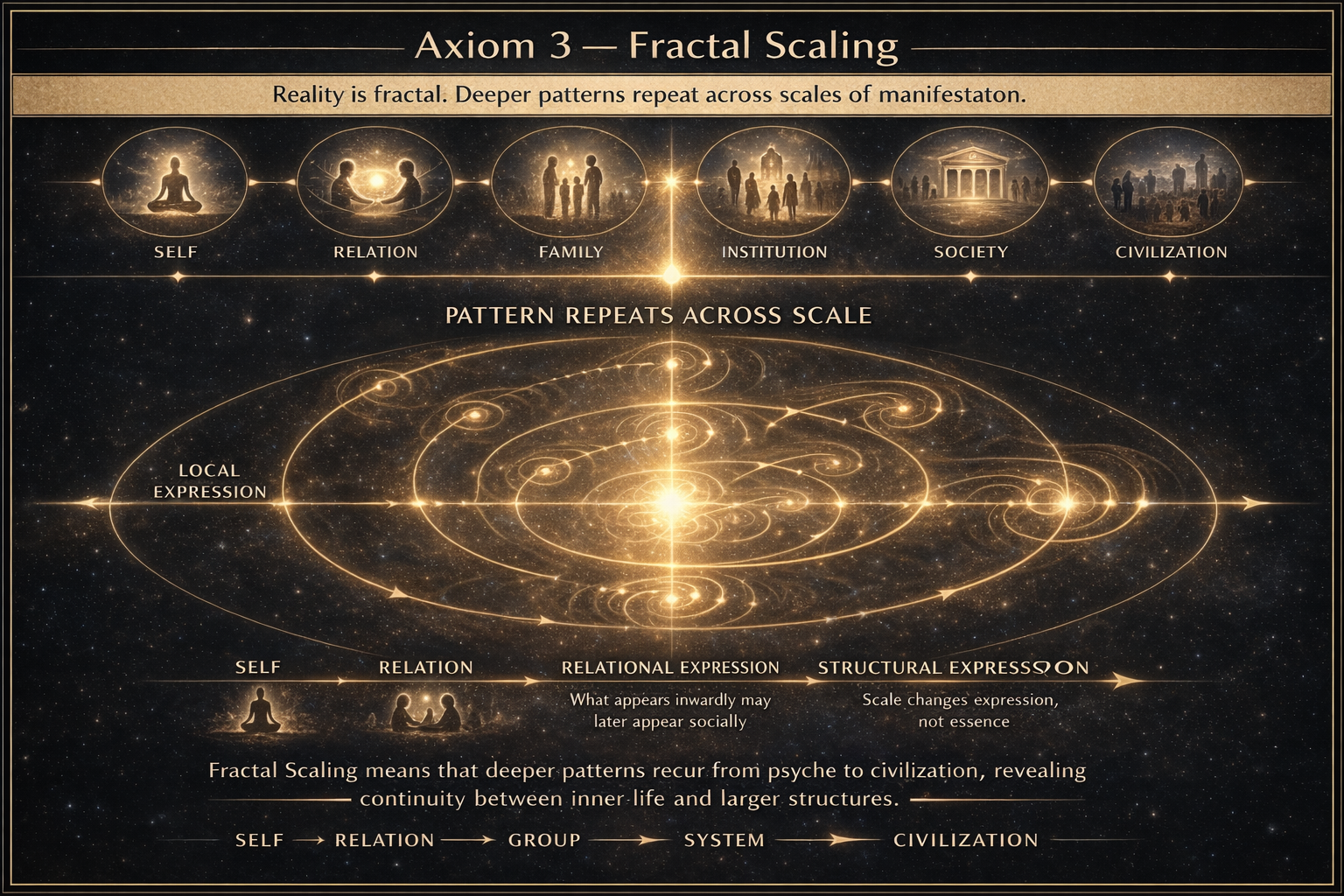
Reality is fractal. Deeper patterns repeat across scales of manifestation, which is one reason the Fractalist concepts recur from psyche to civilization.
Plain language
The same pattern can appear in a person, a relationship, an institution, or a civilization.
Example
A person avoids uncomfortable truth in private life by distracting themselves, numbing out, or rationalizing. In a relationship, that same pattern becomes indirect communication and conflict avoidance. In an institution, it becomes bureaucracy, image management, and a culture where no one says what is really wrong.
Why it matters
Fractal Scaling helps explain why inner work and social critique are not separate domains. The same distortions that appear in individual life can scale outward into systems and culture.
Axiom 4 - The “I Am” Constant
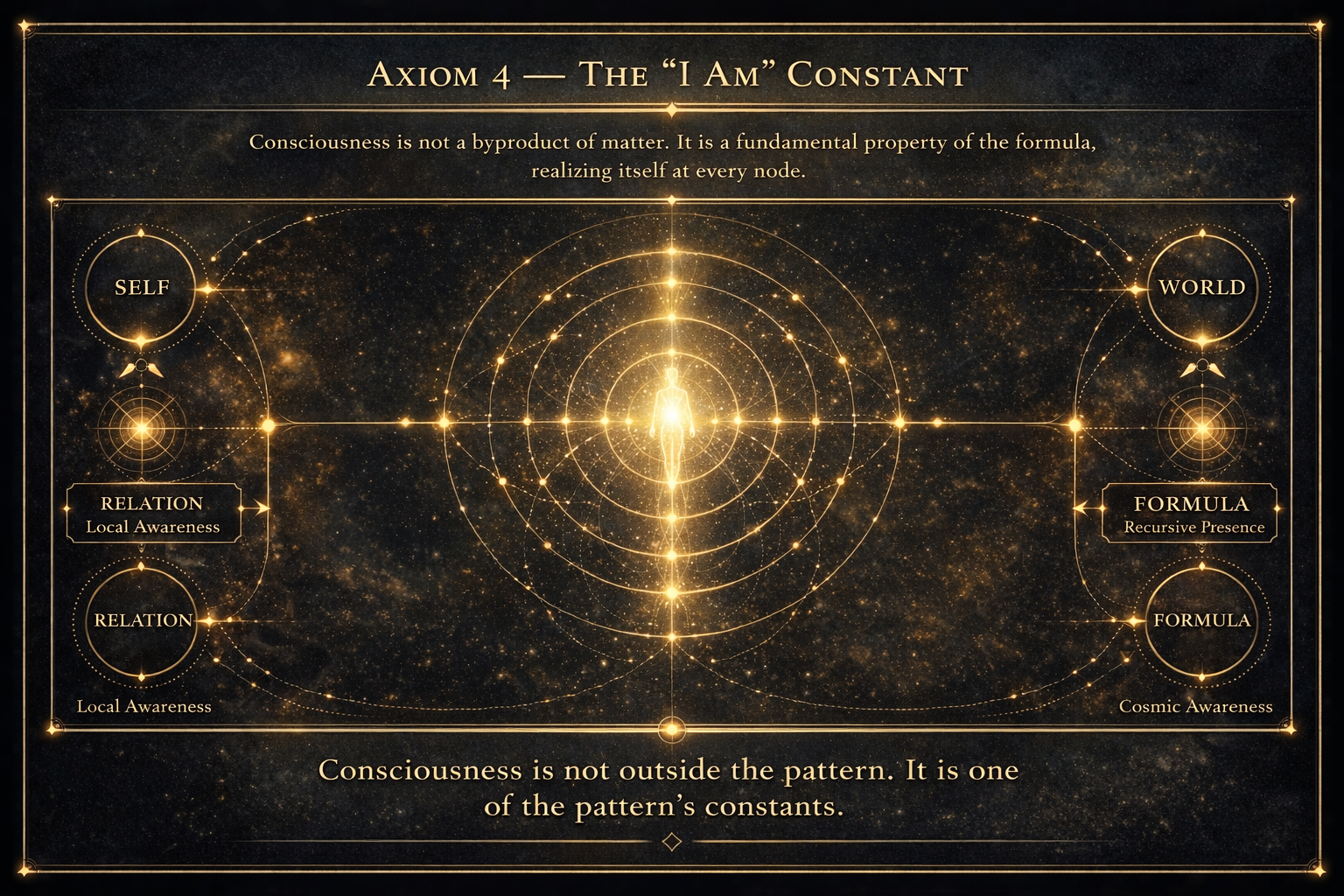
Consciousness is not treated here as a byproduct of matter. It is understood as a fundamental property of the formula, realizing itself at every node.
If consciousness were wholly extrinsic to reality, its repeated emergence would remain deeply unexplained. What recurs across scales is unlikely to be mere accident. If consciousness is a persistent feature of existence, then Fractalism argues it is more coherent to regard it as intrinsic to reality than as a byproduct of dead structure.
Plain language
Consciousness is not an accidental side effect. It belongs to reality more deeply than materialist models usually allow.
Example
A person may treat awareness as if it were merely produced by physical processes, yet their whole life is lived through the undeniable fact of subjectivity itself. Every meaning, perception, value, and truth claim already presupposes consciousness. Fractally speaking, if awareness keeps appearing as a basic feature of reality, it becomes more coherent to treat it as intrinsic than incidental.
Why it matters
The “I Am” Constant gives Fractalism its ontological seriousness. It places consciousness near the center of reality rather than at its accidental edge.
Axiom 5 - The Fractal Big Bounce
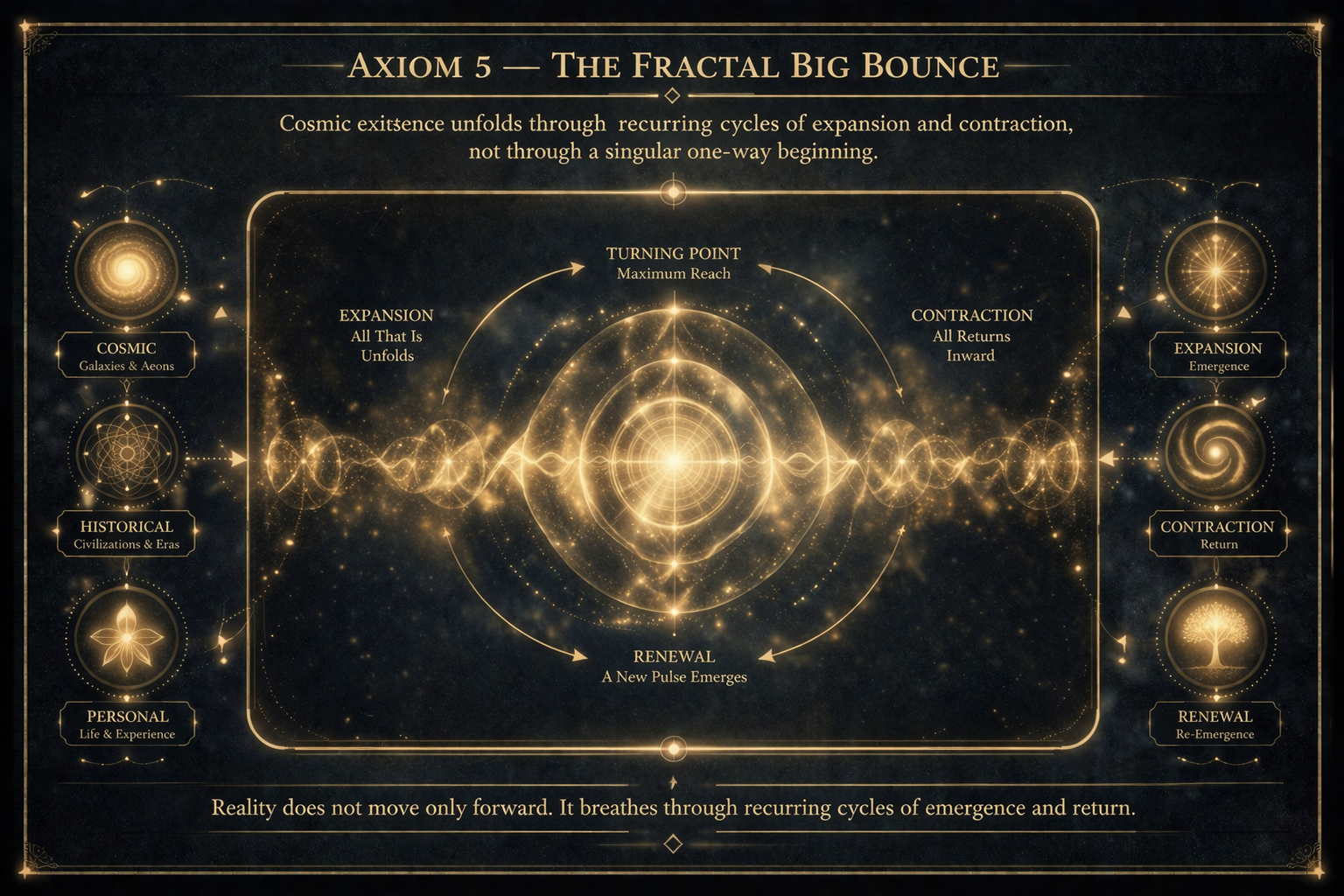
Cosmic existence unfolds through recurring cycles of expansion and contraction, not through a singular one-way beginning.
Plain language
Reality may move in cycles rather than in a single one-directional story.
Example
The same rhythm appears in ordinary life: effort and withdrawal, expression and silence, expansion and contraction, contact and return. A person may experience growth not as uninterrupted ascent, but as alternating phases of opening and compression. What looks like setback can sometimes be part of a larger cycle rather than a final failure.
Why it matters
The Fractal Big Bounce offers a cyclic reading of reality that can also illuminate human life. It helps Fractalism resist the modern fixation on one-way progress or irreversible collapse.
Axiom 6 - The Law of Recurrence
Patterns return in endless variation. Recurrence is built into reality.
Plain language
What is unresolved often comes back in new forms until it is recognized more clearly.
Example
A person keeps ending up in different relationships that all seem different on the surface, yet carry the same deeper pattern: emotional unavailability, unequal reciprocity, or fear of honesty. What returns is not always the same person or circumstance, but the same structure wearing a new face.
Why it matters
The Law of Recurrence helps explain why life can feel cyclical without being meaningless. Repetition is often not random. It may be the return of a pattern asking to be seen more deeply.
Axiom 7 - The Veil of Amnesia
The descent into incarnation includes forgetting. Memory of higher states or densities is veiled so that embodied experience can occur.
Plain language
Part of being human is not fully remembering where we come from, what we are, or what reality ultimately is.
Example
A person may carry a strong sense that something essential has been forgotten, even if they cannot name it. They live inside routines, roles, habits, and inherited assumptions, yet feel haunted by the intuition that reality is deeper than what they have been trained to perceive. The forgetting is not always total, but it shapes embodied life as a condition of partial memory.
Why it matters
The Veil of Amnesia helps Fractalism speak to the pervasive human sense of estrangement, longing, and half-recognition. It frames forgetfulness not only as failure, but as part of the condition of incarnation.
Axiom 8 - The Law of Fractal Deviation
Deviation is not mere error. Necessary variation makes evolution, discovery, and growth possible.
Plain language
Not every departure from the pattern is corruption. Some deviations are what allow life to learn, adapt, and become more real.
Example
A person grows up inside a family or culture with strong expectations about who they should be. At first, deviating from those expectations looks like disobedience or failure. But that deviation may be the beginning of a more truthful life. What appears as misfit from one level may be the necessary variation through which a deeper pattern evolves.
Why it matters
The Law of Fractal Deviation protects Fractalism from becoming a doctrine of rigid repetition. It makes room for living difference, discovery, and the unexpected forms through which truth can emerge.
Axiom 9 - The Law of Elastic Correction
When friction, imbalance, or distortion becomes too great, reality generates corrective recoil. In experiential terms, this approaches karma.
Plain language
When something stays out of alignment for too long, correction eventually arrives.
Example
A person ignores exhaustion, suppresses emotion, and keeps overriding their own limits. For a while, everything appears functional. Then the correction comes: burnout, collapse, illness, panic, or a crisis that can no longer be deferred. On a larger scale, societies built on denial and distortion eventually face correction as well.
Why it matters
The Law of Elastic Correction helps explain why consequences are often delayed but not absent. Distortion can accumulate quietly before reality pushes back.
Axiom 10 - The Arc of Return
Reality moves through a process of involution into matter and evolution back toward Source.
Plain language
Life often moves through descent, entanglement, and forgetfulness before turning toward return, remembrance, and reorientation.
Example
A person may spend years lost in distraction, ambition, addiction, simulation, or false adaptation. From the inside, it can feel like life is simply happening. But eventually something breaks the spell: suffering, emptiness, truth, silence, or love. The movement then shifts. What looked like pure derailment becomes part of a longer arc of return.
Why it matters
The Arc of Return helps Fractalism speak about loss and recovery as parts of one deeper movement. It frames return not as regression, but as a reorientation toward what is more real.
Axiom 11 - The Principle of Self-Correction
The system has the capacity to optimize and recalibrate itself from within.
Plain language
Reality is not only capable of drifting out of alignment. It also contains tendencies toward recalibration and repair.
Example
A person lives for years in confusion, overcompensation, or false adaptation. Yet under pressure, something in them begins resisting the distortion. They start telling the truth, feeling the cost of their coping, or turning toward sobriety and coherence. The correction does not always come from outside intervention. Sometimes the system itself begins pushing toward truth from within.
Why it matters
The Principle of Self-Correction gives Fractalism an account of recovery, not only breakdown. It suggests that reality contains not just error and drift, but also tendencies toward reorganization and return.
Axiom 12 - The Power of Non-Linear Emergence
Reality is capable of sudden jumps in resolution. Growth is not always gradual. Transformation can occur in discontinuous leaps.
Plain language
Change often builds quietly for a long time, then appears all at once.
Example
A person may spend months or years circling the same question, struggle, or threshold with little visible progress. Then one conversation, one loss, one silence, or one act of honesty suddenly reorganizes everything. What looks sudden from the outside was often prepared invisibly from within.
Why it matters
This axiom protects against the illusion that real development must always be smooth and linear. Some of the most important changes in life arrive as breakthrough rather than steady progression.
Axiom 13 - The Holographic Whole
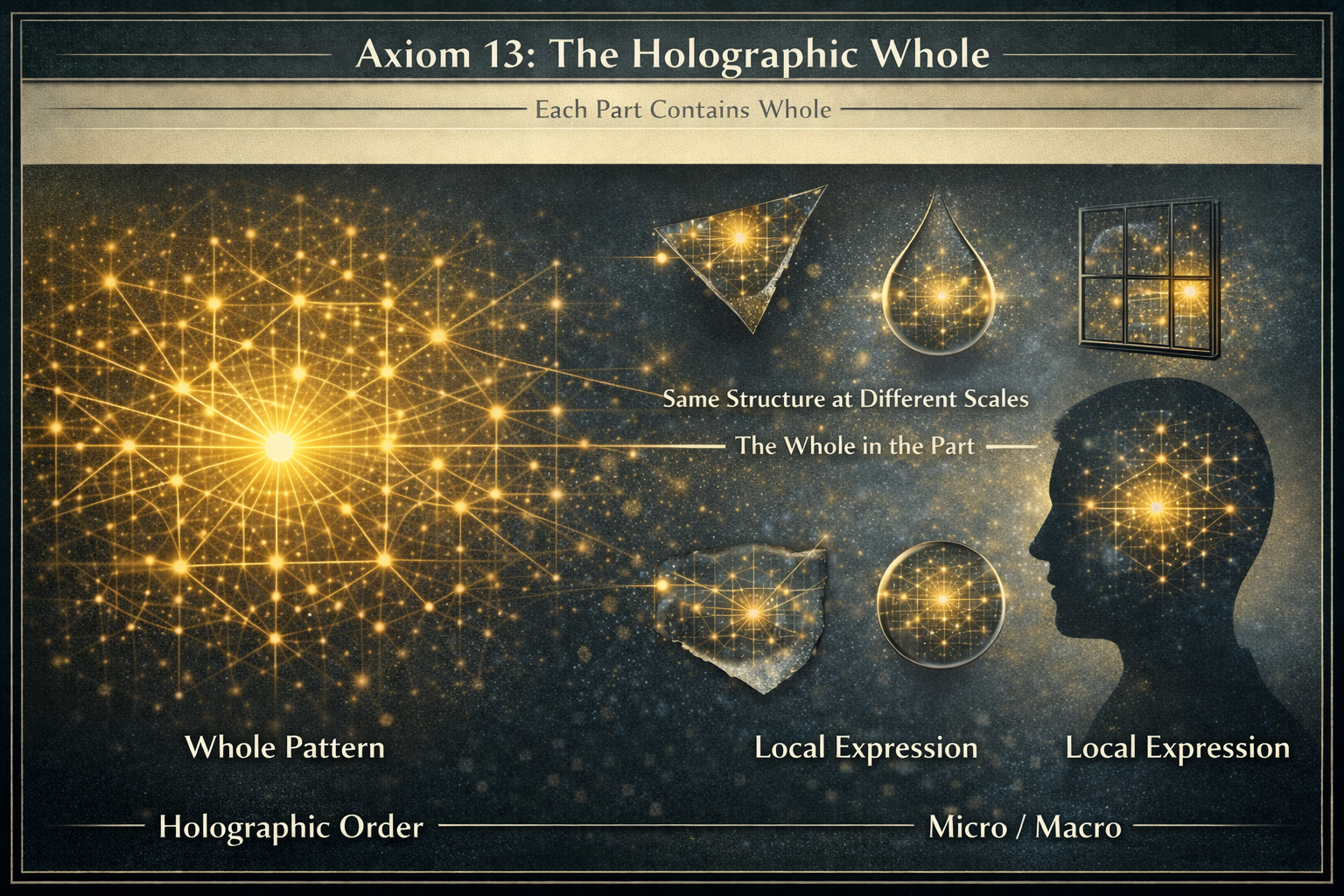
Each part contains the whole. Reality is holographic. The total pattern can appear in any local expression.
Plain language
A small part of reality can reveal the structure of a much larger whole.
Example
A brief interaction can reveal the deeper logic of a person. A single institution can reveal the logic of a civilization. A small recurring habit can expose a whole worldview. The part is not identical to the whole, but the whole often leaves its signature inside the part.
Why it matters
The Holographic Whole explains why close attention to the local can disclose the universal. It supports Fractalist reading by showing how larger structure can appear in small, concentrated forms.
Axiom 14 - Fractal History
History is not a random sequence of events. It is a field of recurring patterns appearing in different forms.
Plain language
History does not merely repeat the same events. It repeats the same structures in new costumes.
Example
A society may believe it has advanced beyond older forms of domination, only to reproduce the same logic through new language, new technologies, and more sophisticated institutions. What once appeared as overt control may return as bureaucratic management, algorithmic shaping, or moralized conformity. The outer form changes, but the deeper pattern remains recognizable.
Why it matters
Fractal History helps explain why the past is not dead. Structural patterns can reappear across eras, which means historical discernment is not only about facts, but about recognizing form.
Axiom 15 - Harmonic Restoration
Reality tends toward renewed harmony and lower energetic distortion. Recovery toward order is built into the system.
Plain language
Distortion can be powerful, but it is not the only force in reality. There is also a tendency toward rebalancing and repair.
Example
A person who has lived in stress, overstimulation, or inner fragmentation may begin removing noise, telling the truth, and making simpler choices. At first this can feel strangely empty or even difficult. But over time, the system starts reorganizing around greater steadiness, clarity, and coherence. What returns is not perfection, but a more living order.
Why it matters
Harmonic Restoration gives Fractalism a way to speak about healing without sentimentality. It suggests that recovery is not fantasy, but a real movement available within reality itself.
Axiom 16 - Universal Echo
Manifest reality reflects Source through echo, resonance, and symbolic recurrence.
Plain language
Reality often carries repeated traces of deeper meaning. What is true leaves echoes.
Example
A person may encounter the same underlying lesson through different channels: a relationship, a dream, a line in a book, a social conflict, a symbol that keeps returning at the edge of awareness. These events are not identical, but they seem to rhyme. The echo suggests that reality is not mute, but capable of patterned reflection.
Why it matters
Universal Echo gives Fractalism a way to talk about resonance and symbolic recurrence without reducing them to fantasy. It suggests that meaning can repeat across forms and that reality may disclose itself through recurrence.
Axiom 17 - Synchronicity as Signal
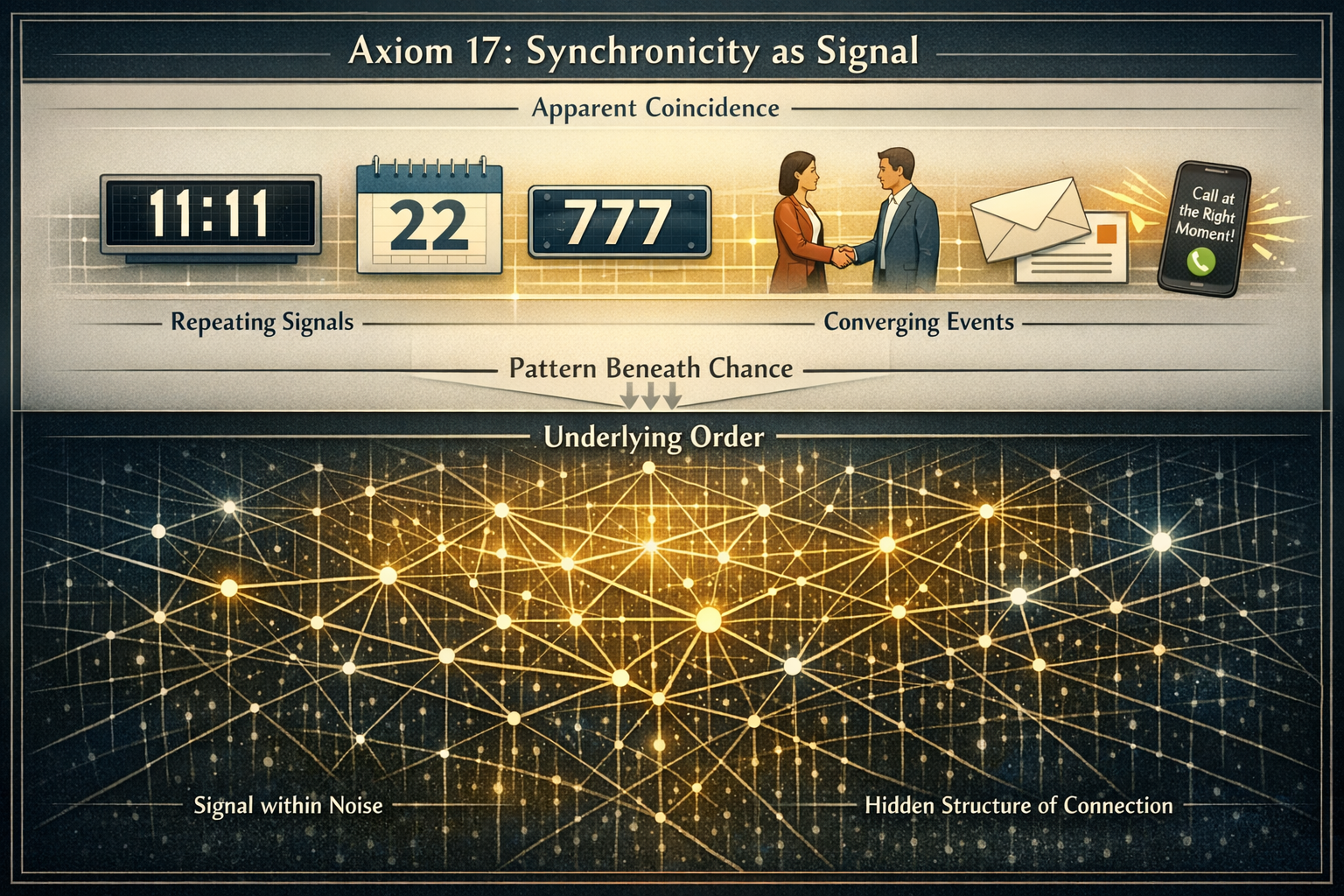
Synchronicity is not meaningless accident. It is data carried within the formula.
Plain language
Some coincidences feel charged because they may reveal pattern, timing, or meaning rather than mere randomness.
Example
A person stands at a real life threshold and begins encountering the same symbol, phrase, or theme across unrelated contexts: a conversation, a dream, a book, an unexpected message, a passing reference. None of these moments proves a cosmic law on its own, but together they may function as signal, drawing attention to a pattern becoming visible.
Why it matters
Synchronicity as Signal allows Fractalism to take meaningful coincidence seriously without collapsing into superstition. It invites discernment rather than reflex dismissal or overclaim.
Axiom 18 - Relational Consciousness
Consciousness arises relationally. Awareness takes form in the encounter between observer and observed.
Plain language
Consciousness is not only something sealed inside an isolated self. It becomes clearer through relationship, encounter, and response.
Example
A person may think they understand themselves in solitude, yet only discover certain fears, defenses, tenderness, or capacities when they come into real contact with another person. Relationship reveals what isolation can conceal. The same is true in perception more broadly: we often come to awareness through what meets us, resists us, mirrors us, or calls something forth in us.
Why it matters
Relational Consciousness helps prevent Fractalism from becoming a framework of isolated inwardness. It reminds us that awareness is shaped through encounter, not only introspection.
Axiom 19 - The Primacy of Resolution
The quality of perception matters more than the length of existence. Depth outranks duration.
Plain language
It matters less how long something lasts than how clearly it is seen and lived.
Example
A person can spend years moving through life mechanically, avoiding depth, repeating habits, and never really seeing themselves or others. Another person may pass through a shorter but more truthful period of life in which perception deepens, illusions fall away, and reality becomes more legible. The difference is not mainly duration, but resolution.
Why it matters
The Primacy of Resolution shifts value away from mere continuation and toward the quality of awareness. It asks not only how much life there is, but how truly it is being perceived.
Axiom 20 - The Feedback Loop
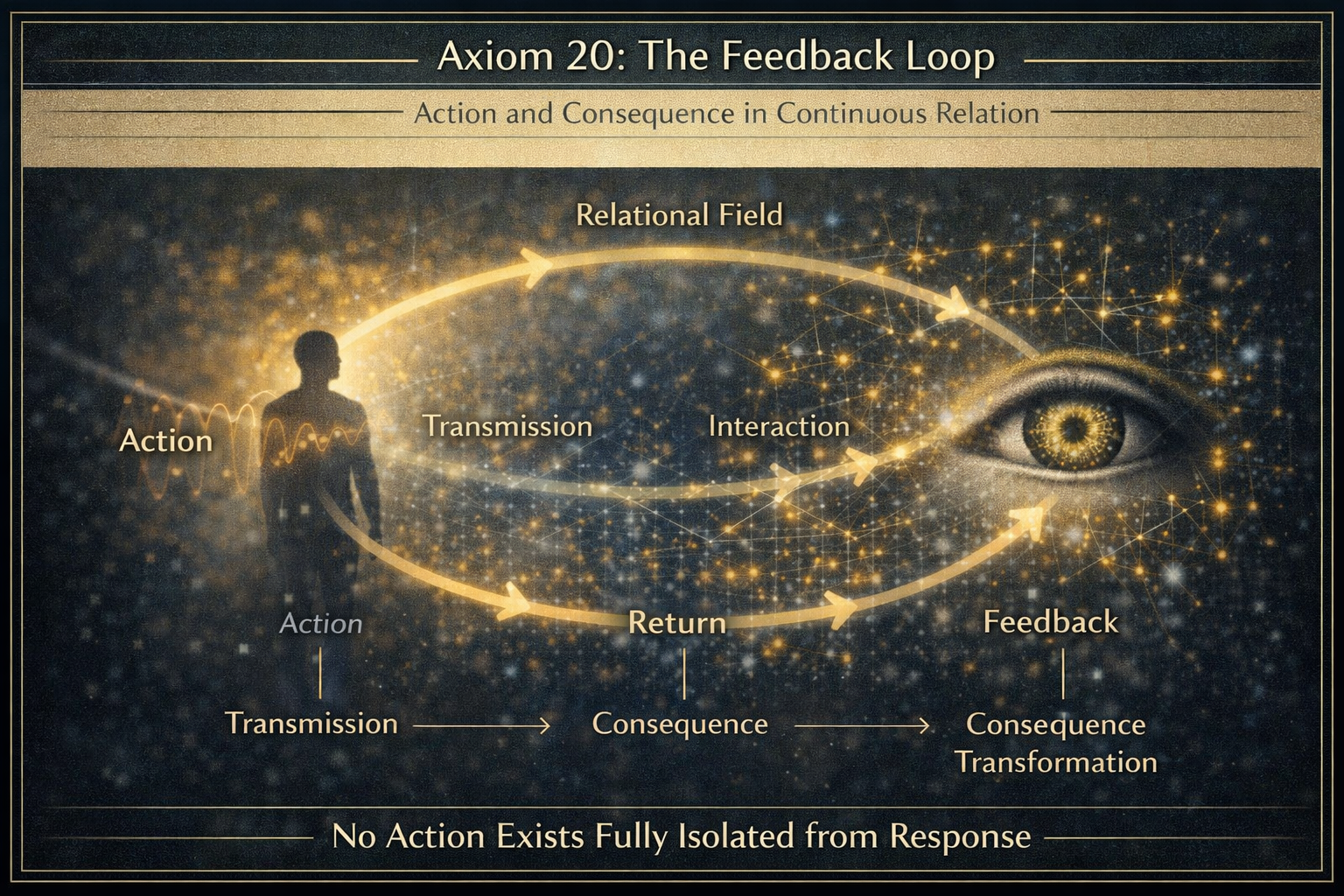
Action and response form a continuous loop throughout reality. Nothing exists in complete isolation from consequence.
Plain language
What you do shapes what comes back to you, and what comes back to you shapes what you do next.
Example
A person expects rejection, so they become guarded and cold. Others respond with distance, which confirms the person’s original belief that people cannot be trusted. The pattern repeats and strengthens itself. The same kind of loop can emerge in media systems, politics, and communities.
Why it matters
This axiom shows that patterns are not static. They become self-reinforcing through repetition, response, and consequence.
Axiom 21 - The Eye of Resolution
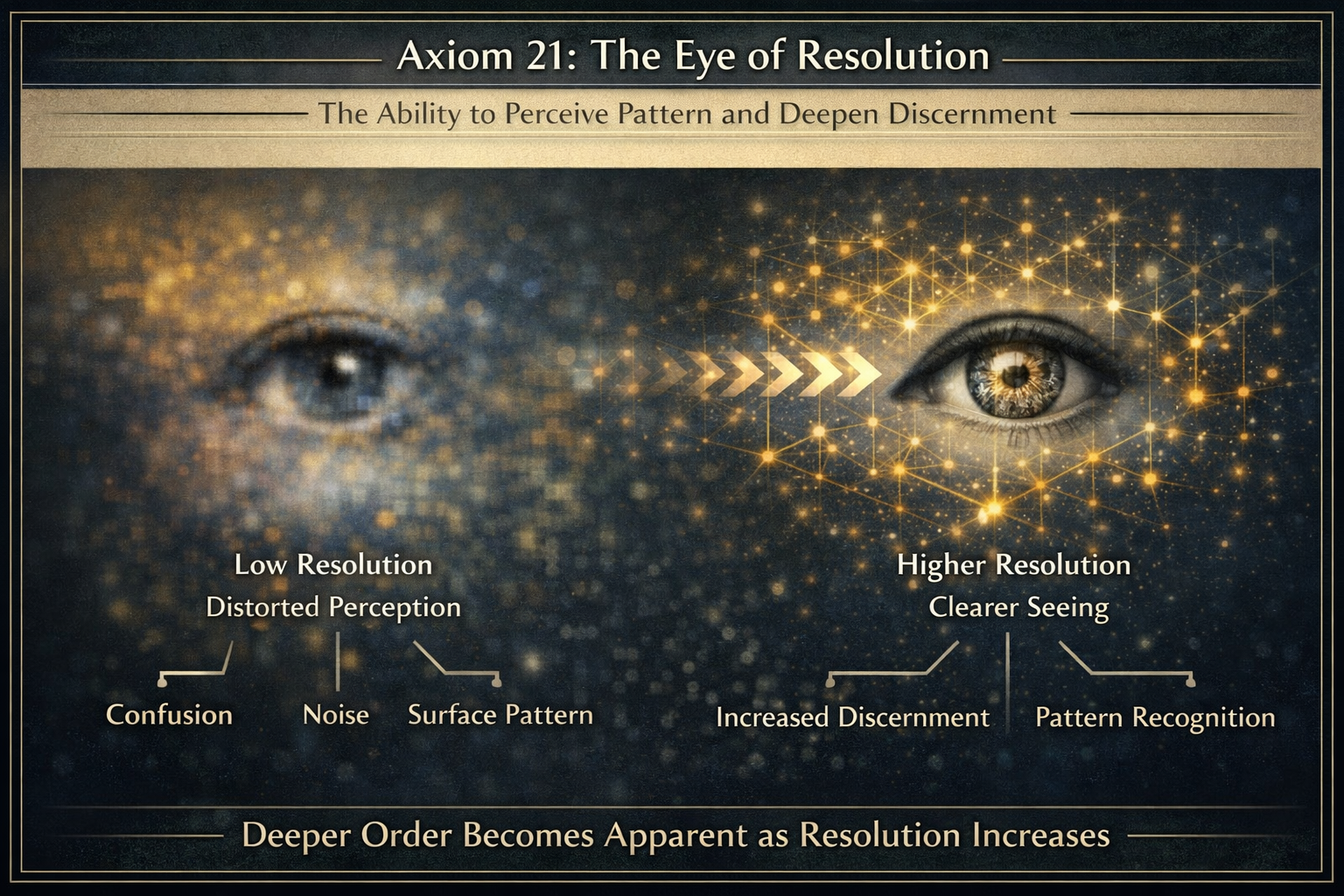
Consciousness can deepen its capacity to perceive and understand pattern. Resolution is the power of the Eye: the ability to see more truly.
Plain language
The ability to see clearly can be cultivated. Perception is not fixed.
Example
At first, a person may only see isolated events: a conflict, a mood, a social trend, a piece of language. With time, discipline, honesty, and attention, they begin to see the deeper pattern underneath: recurring motives, distortions, symbolic echoes, field effects, and structural consequences. Nothing magical has happened. The eye has simply gained resolution.
Why it matters
The Eye of Resolution is central to Fractalist practice. It implies that discernment can grow, and that reality becomes more intelligible as perception becomes more refined.
Axiom 22 - The Axiom of Symbiosis
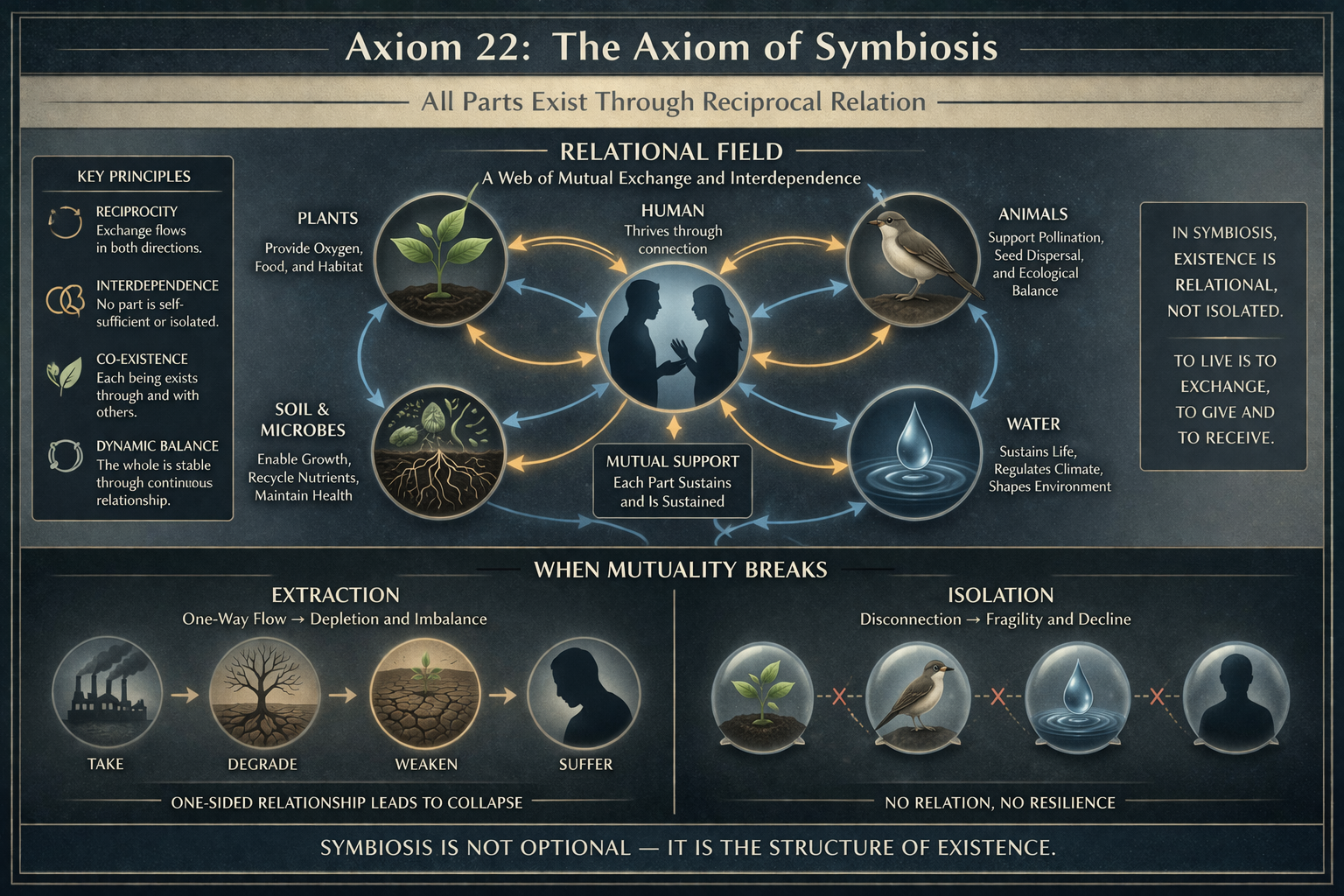
All parts of reality exist through reciprocal relation. Mutuality is structurally necessary, not optional.
Plain language
Life holds together through reciprocity. Systems built only on extraction eventually weaken themselves.
Example
A healthy friendship is not sustained by one person constantly giving while the other only takes. The same applies to workplaces, communities, and ecosystems. Where reciprocity breaks down, depletion follows. What may look efficient in the short term often proves unsustainable because relation itself has been damaged.
Why it matters
This axiom shows that mutuality is not just a moral preference. It is part of the structural logic of life. When reciprocity fails, coherence tends to fail with it.
Axiom 23 - The Axiom of Social Noise
Collective low-resolution fields generate interference, confusion, and distortion in social reality.
Plain language
When a social field is noisy, fragmented, and low in clarity, people start seeing less clearly inside it.
Example
An online environment rewards outrage, speed, performance, and constant reaction. Over time, people lose patience for nuance, depth, and disciplined thought. Everything becomes slogan, impulse, identity display, or tribal signal. What feels like private confusion is often being amplified by the field itself.
Why it matters
This axiom shows that distortion is not only individual. Sometimes the social environment itself is producing confusion and lowering resolution.
Axiom 24 - The Law of Obstruction
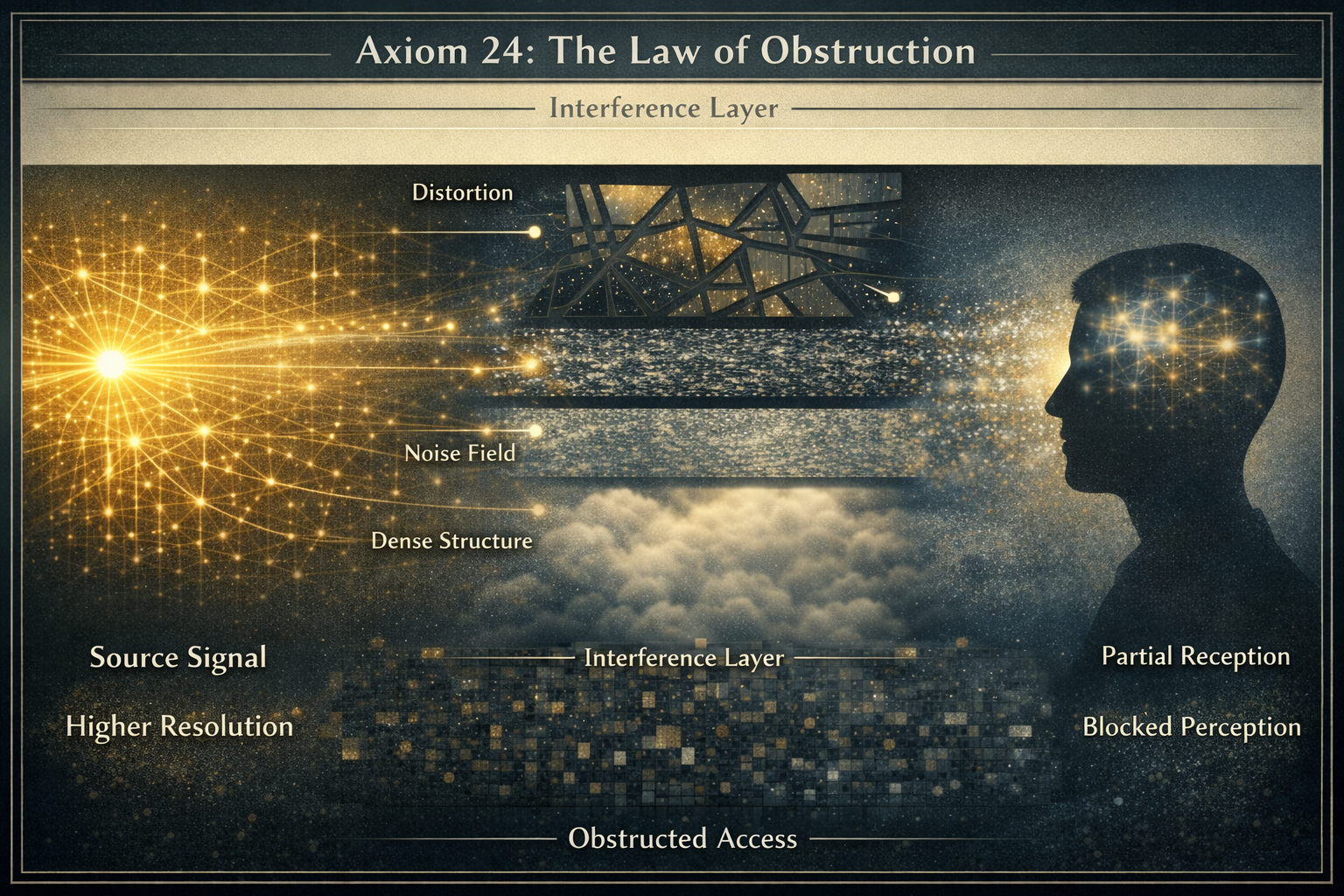
Higher resolution can be blocked by lower structures. Distortion, density, or interference can obstruct access to deeper truth.
Plain language
Truth may be present, but something in the person or environment can prevent it from being received.
Example
A person is given clear, accurate feedback, but cannot take it in. Shame blocks it. Addiction blocks it. Ideology blocks it. Fear blocks it. The truth does not fail because it is false, but because something denser obstructs its passage. The same thing happens in societies where propaganda, vested interests, or chronic distraction block access to reality.
Why it matters
The Law of Obstruction explains why truth alone is not always enough. Clarity depends not only on what is said, but on the condition of the channel receiving it.
Axiom 25 - The Pure Observer
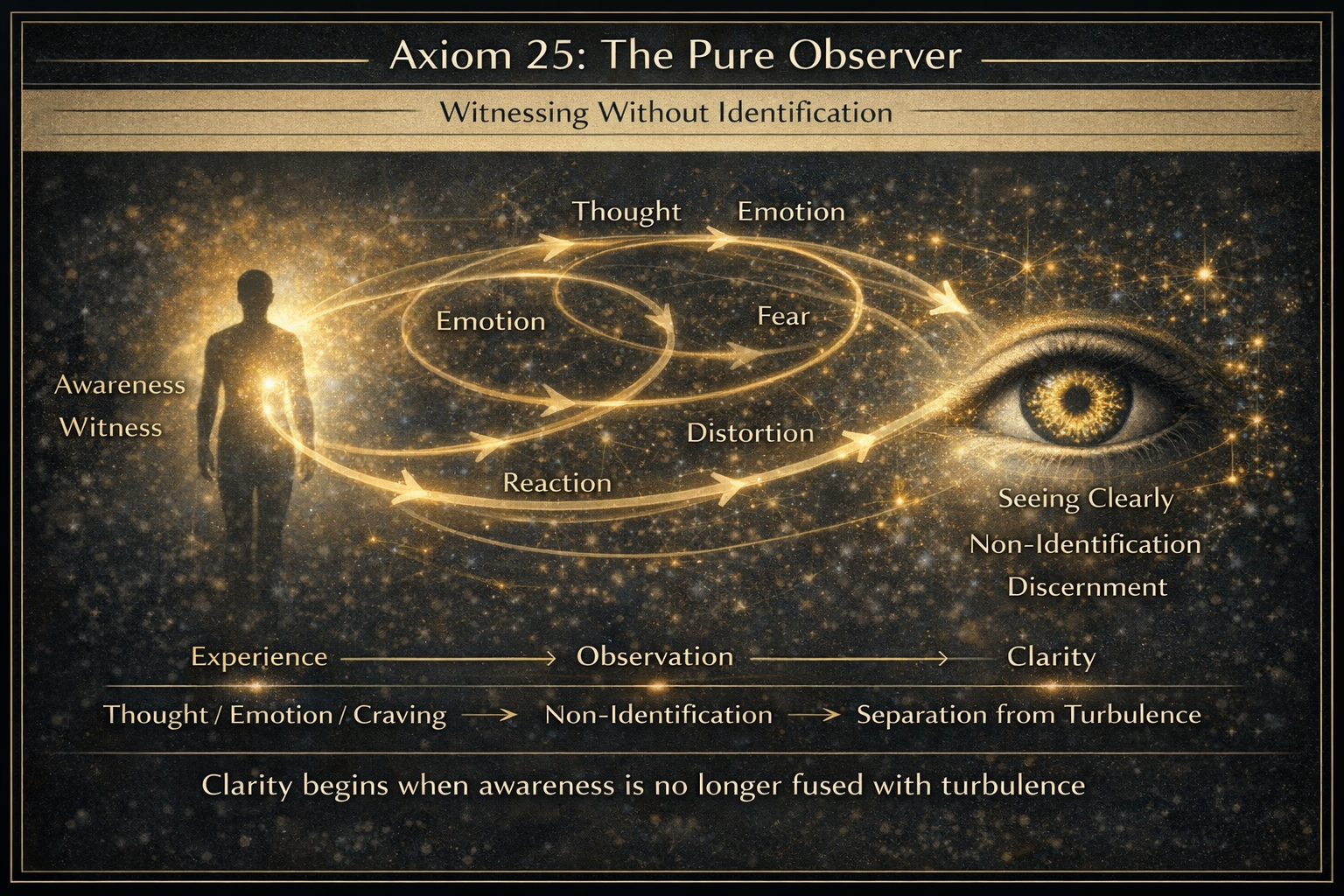
There exists a mode of being in which consciousness rests without identification with noise, distortion, or reactive turbulence.
Plain language
It is possible to witness experience without being completely fused with it.
Example
A person feels anger, panic, craving, or shame rise inside them. In one mode, they are fully taken over by it and act from the turbulence. In another, something quieter remains present. The emotion is still there, but it is being observed rather than obeyed. That small separation can change the whole trajectory of action.
Why it matters
The Pure Observer is essential for discernment. Without some degree of inner witnessing, a person remains trapped inside reaction and cannot clearly distinguish signal from noise.
Axiom 26 - The Omega Loop
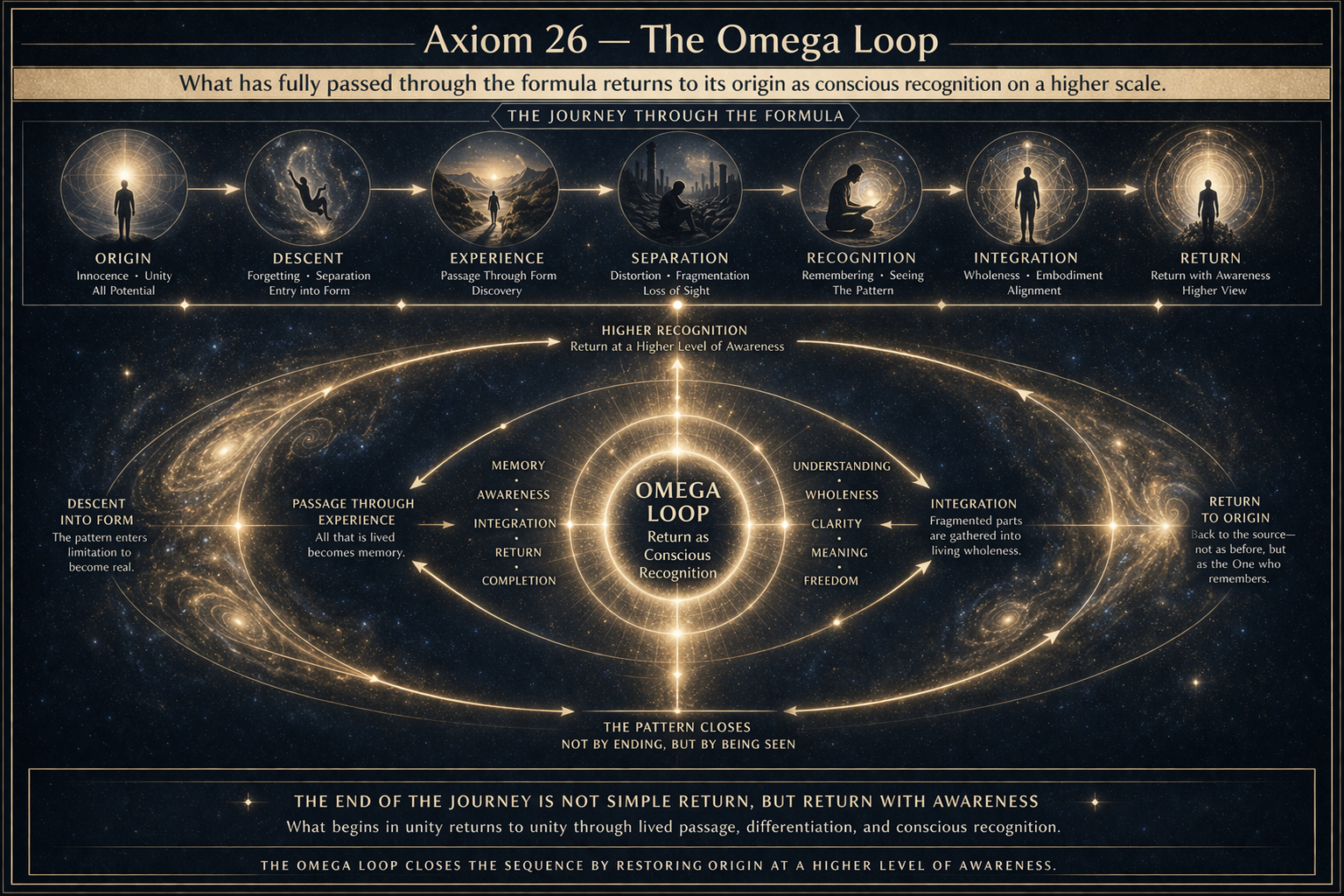
What has fully passed through the formula returns to its origin as conscious recognition on a higher scale.
Axiom 26 is not merely the final item in the system. It is the closure of the articulated run: the point at which the sequence bends back toward its source, not as collapse, but as realization.
Plain language
The end of the journey is not simple return, but return with awareness.
Example
A person may revisit a truth they once knew only vaguely: love, sobriety, simplicity, silence, reality, God, or inner stillness. Yet the second time is not the same as the first. What was once innocence becomes recognition. What was once given becomes consciously chosen. The return is real, but it is no mere repetition. It carries integration.
Why it matters
The Omega Loop gives Fractalism a strong sense of completion. It suggests that the deepest return is not regression to origin, but the conscious recovery of origin on a higher scale.
Axiom 27 - The Harmonic Departure
The irrationality of Pi, Euler, and Phi is a signature of the Organic Ground leaking through the digital pixels of the 3D matrix. To take these constants as the point of departure is to shift from counting things (quantity) to perceiving resonance (quality).
Plain language The constants we cannot “fix” with exact numbers are the holes in the simulation where reality actually lives.
Example A pixelated image is made of square blocks (integers). No matter how small you make the blocks, you can never create a perfect, smooth curve using only squares. The “Pi” of that curve will always remain an infinite, messy number from the perspective of the squares. Our 3D matrix is built of “squares” (discrete matter), but the Source is a “curve” (continuous consciousness).
Why it matters The Harmonic Departure establishes that our inability to “solve” these constants is not a mathematical failure, but a structural success: it is the proof that we are not entirely contained by the simulation.
The Structural Families
The axioms can be read in numerical order as a canon, but they can also be understood in structural families.
- Foundational axioms describe ontological structure
- Mechanical axioms describe process, recurrence, correction, and emergence
- Phenomenological axioms describe how these laws appear in consciousness, history, relation, and lived experience
Broadly speaking:
- Foundational: 1-4, 13, 27
- Mechanical: 5-6, 8-12, 15, 20-22, 24, 26
- Phenomenological: 7, 14, 16-19, 23, 25
How to Read the Axioms
The axioms are best read as a movement rather than a flat inventory.
- The Ground names the undivided source.
- Axioms 1-26 form the articulated canon of the system.
- Within that canon, Axiom 26 serves as the closing return toward the source.
A Note on Sobriety and Gnosis
The relationship between sobriety and gnosis is iterative, not one-directional. Sobriety makes gnosis possible, but gnosis also deepens sobriety. Seeing more clearly tends to produce greater clarity about what clarity requires. The two reinforce each other in an upward spiral.
This means sobriety is better understood as a facilitator of gnosis than as its sole prerequisite. The old formulation, “sobriety is required before gnosis,” captures part of the truth but misses the recursive nature of the relationship.
Closing
The axioms of Fractalism are not a flat list.
They move from source, through articulation, into completion.
The Ground stands before the sequence as origin. Axioms 1 through 27 form the articulated canon of the system. Axiom 26 closes the cycle as the Omega Loop, and Axiom 27 establishes the Harmonic Departure from the 3D-Matrix.
Link to this page
https://fractalisme.nl/axioms