Essay
The Source in You
You are not your brain. You are a formula, a complete expression of the whole, and the whole lives inside you.

There is something you probably already know, but that never gets the space to land.
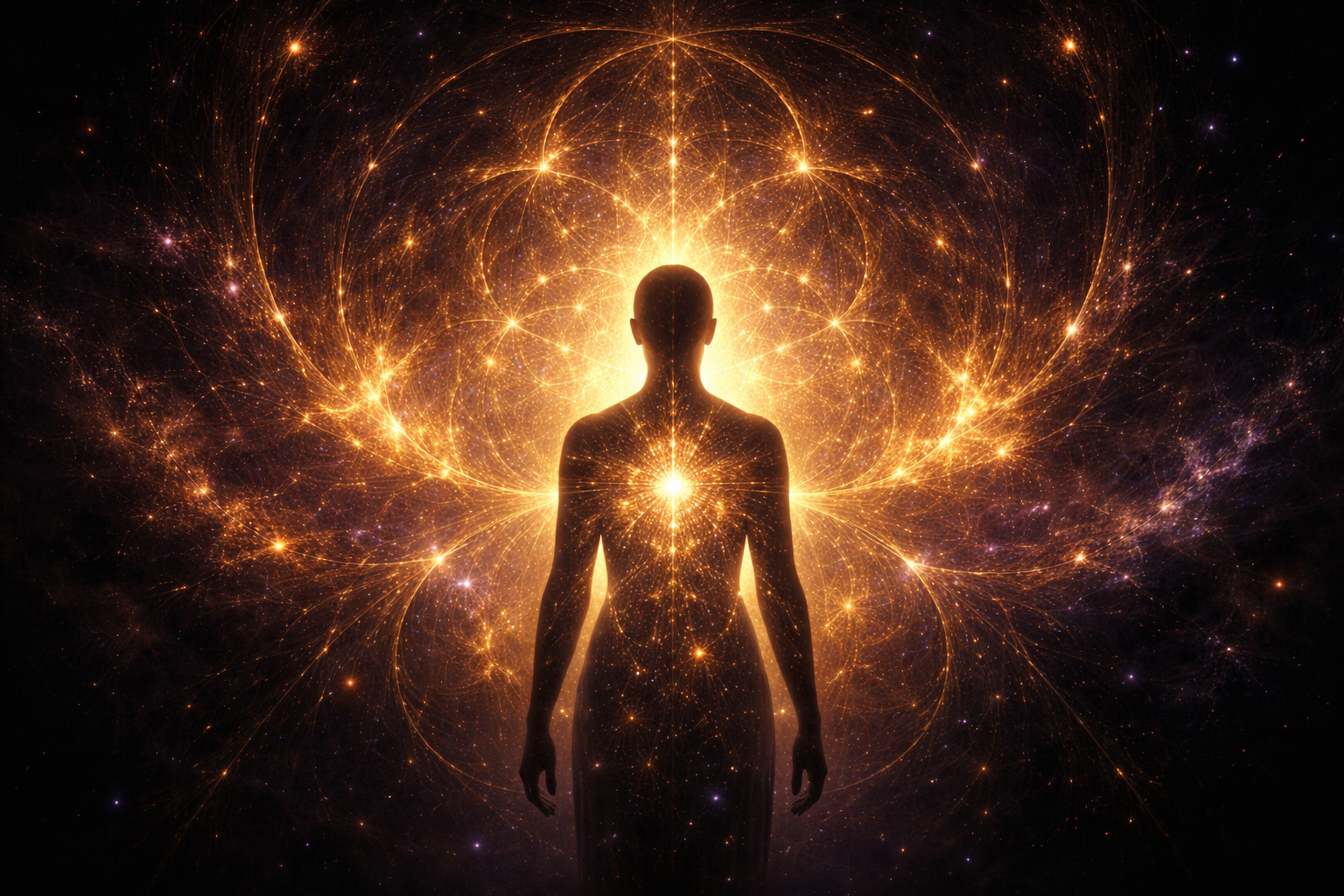
You are not your brain. You are a formula, a complete expression of the whole, and the whole lives inside you the way a seed carries everything the tree will become. The difference between you and the Source is not nature, it is scale. Not a difference in kind, only in degree. Every wave carries the ocean forward. Every frequency holds the whole spectrum. You are not less than the Source. You are the Source, in one particular form.
This is not spirituality in the airy sense. It is a remembering of something that was never gone.
The world teaches you something different. The world teaches you that you are a biological machine, that consciousness is a byproduct of matter, that your decisions are the result of causal chains lying outside of you. That is the mechanical view, and it is incomplete. It sees the screen and misses the current. It describes the surface and calls it the whole story.
But there is something underneath that view.
You can notice it in the moment before a thought finishes. In the gap between stimulus and response. In the quiet when the noise falls away. What you notice there does not present itself as a thing, it has no edges, no location, no weight. But the quality of what happens in that space is unmistakably different from what happens when chemistry runs the show. You do not have to call it divine to notice that it is there. You only have to pay attention to your own experience and notice what is actually happening.
Consciousness is not a byproduct. It runs the other direction, matter may arise from it, not the other way around. This is not proven, and anyone who tells you otherwise is selling something. But the mechanical view has never explained why there is something it feels like to be conscious. It describes the brain with extraordinary precision and says nothing about experience. And when a description fails to account for the thing it is describing, the description is incomplete. Not wrong, incomplete. That distinction matters.
This is not an argument against science. It is an argument for science that takes experience seriously as a real phenomenon, not as an illusion to be reduced.
The brain is the screen. The Source is the current. You can look at the screen and think you understand electricity because you see the picture, and still know nothing about what is actually flowing through the wire.
The Void in Fractalism is where you find this. Not as emptiness, not as nihilism, but as the space where the noise becomes quiet enough to hear what is underneath. There, in that silence, you might expect to find a self, some inner observer that has been there all along, watching from the inside. But what you find is not that. It is closer to the opposite: not a watcher, but the capacity to watch. Not a chosen, but the capacity to choose. These are not things with edges. They are what experience is made of when it is not yet shaped into story.
There is a shadow to this, and here is where most writing of this kind looks away.
The Void does not guarantee you will find light. Some people go down and find only their own destructiveness staring back. depth psychology was right about this, the psyche has dark currents that move toward dissolution, toward collapse, toward the things that eat you from the inside. The Void does not promise you a pleasant encounter. It promises only that what is there can be seen. And what is seen can be related to rather than merely obeyed. But the seeing itself is not clean. It costs something. It demands that you stay with what you find long enough to understand it, and that is not something most people want to do. The light is not the point. The seeing is the point.
Determinism tells you that you are the surface. That you are your chemistry, your conditioning, your history. That you cannot be more than what caused you. The effect is subtle but unmistakable: you begin to feel that you have no ground of your own. That you are the result of causes that have nothing to do with you. This is not a conspiracy. It is what happens when a framework mistakes the map for the territory, when the description of matter becomes a description of you. The framework is not wrong. But you are not only what the framework describes.
If you are the Source in your particular form, then the surface is not all you are. The patterns are things you carry, not things you are. And from that relationship, carrying rather than being identical to, something else becomes possible. Not omnipotence. Not escape from causality. But the possibility of a different relationship to what moves through you.
The question is not whether you are special in the way theology means it. The question is whether you are willing to take seriously the possibility that you are not only what your circumstances made you. Whether you can sit with that and see what follows.
What remains for me after all this is not a conclusion. It is more like a direction. Something that was here before the body formed and will be here after it dissolves. Not separate from the body. Not indifferent to it. But not exhausted by it either. You learn this not by reading it but by going into the Void and staying there until you stop expecting the light. Until you realize the seeing is what you were looking for, and it was always here, and it was never yours to keep or to lose.
That is the Source. Not distant. Not separate. Here, in this, in you.
Link to this page
https://fractalisme.nl/the-source-in-you