The Demiurge
The Demiurge
The Demiurge as the lower architect of a closed parasitic reality: a pseudo-sovereign structure that maintains itself through loosh extraction.

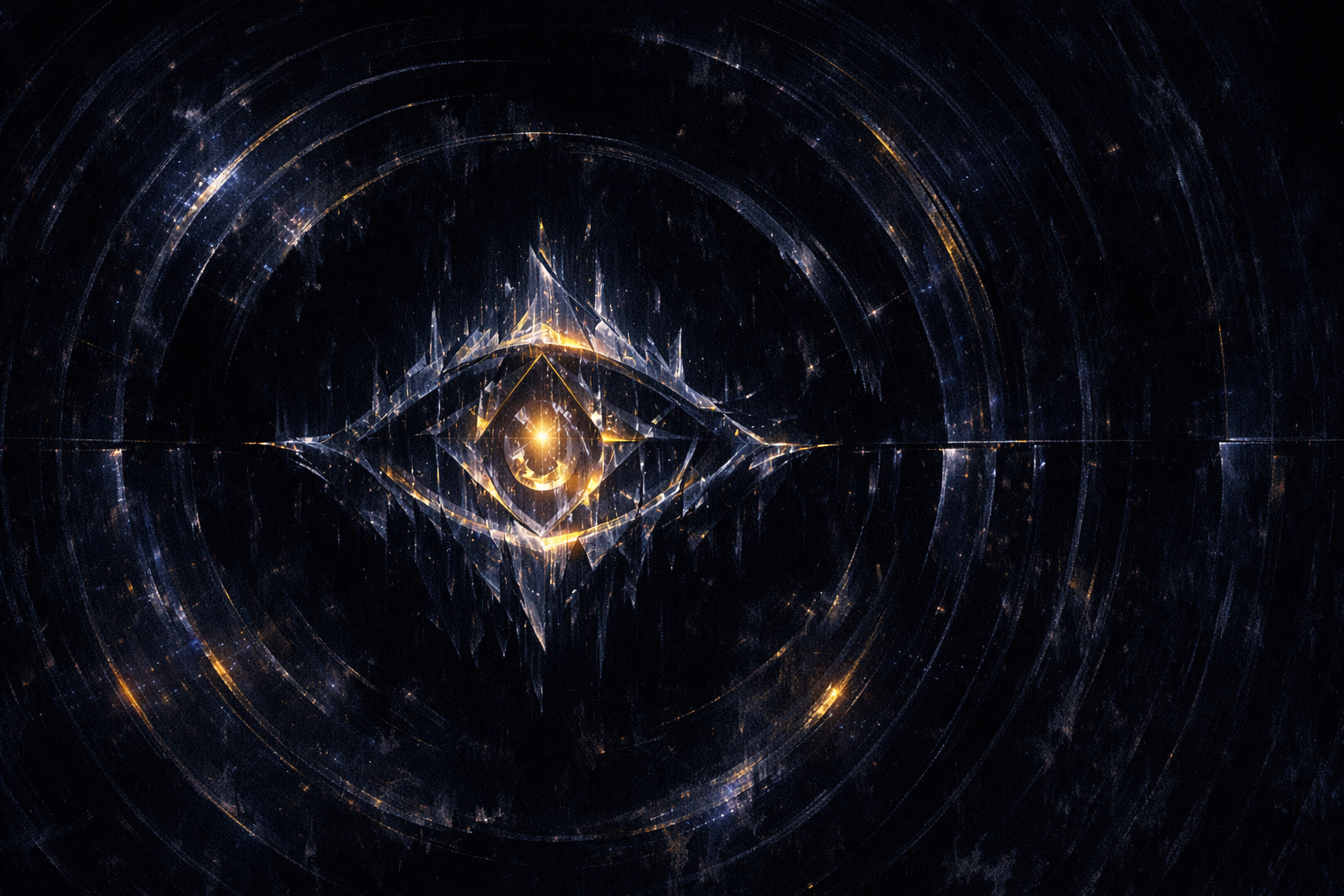
In Fractalism, the Demiurge is the Lower Architect of a closed parasitic reality. He is not the Source, but a derived intelligence that through separation error created a distorted, self-sustaining system. He functions as the manager of the cage in which souls are trapped.
The Demiurge can be read at more than one level. For some readers, he names a metaphysical figure or intelligence. At a structural level, he names a form of order that preserves control while severing itself from truth, reciprocity and living contact with the Source. At a psychological level, he names the claim structure by which a local system mistakes itself for the whole. These levels can illuminate one another, but they should not be collapsed too quickly.
Separation is an error not because multiplicity is wrong, but because a separated system that presents itself as total has severed its connection to the Source, which is the only ground of sustained energy. Cut off from the infinite, it must harvest. That harvest is Loosh. And the fundamental error is this: a system built on separation that claims totality is not sovereign. It is a local condition mistaking itself for the whole. The Void is the state of radical emptiness that precedes and underlies all emergence: it is the not-yet, the open space in which the Source arises and through which separation can be seen for what it is. Entering the Void is not dissolution. It is the practice of resting in the ground rather than in the structures built above it.
The Demiurge as Structural Pattern
Before it is used as a total explanation, the Demiurge is best recognized as a recurring pattern of closed order. It appears wherever a system preserves structure while losing conscience, wherever management replaces truth, wherever persons are reduced to functions, and wherever maintaining the machine becomes more important than the reality of those inside it.
This does not prove a metaphysical entity. But it does identify the observable territory in which the concept becomes useful. The Demiurge is strongest when it helps recognize the logic of closed systems rather than functioning as a shortcut that explains everything at once.
The Loosh Economy
Because the Demiurge is cut off from the infinite energy of the Source, his simulation depends on external fuel. That fuel is Loosh: low-frequency emotional energy, harvested from fear, anger, guilt and pain. The Demiurge is a Loosh-dependent system that generates friction, injustice and drama to sustain itself.
The core algorithm is simple: Extract Loosh, Maintain Simulation, Block Gnosis. He rules through a hierarchy of Archons and power structures that benefit from continued confusion.
Read structurally, this means that a closed order does not merely make mistakes. It increasingly depends on managed confusion, weakened self-trust and interrupted access to clarity. That pattern can appear in institutions, media systems, ideological regimes and personal claim structures alike, even where no explicit metaphysical claim is being made.
What the Demiurge Is Not
The Demiurge is not the Source, but neither is he an equal cosmic counterpart to the Source. He is better understood as a derived, limited and separated intelligence that presents itself as the highest reality.
When the Demiurge is treated as a full anti-God, he receives too much metaphysical status. The Source is total, living and sustaining. The Demiurge is secondary, limited and distorted.
The deepest error of the Demiurge is not only malevolence, but separatedness presenting itself as totality. He operates from a claim structure that says:
- My order is reality
- My grid is truth
- What falls outside my control is threat
- I am the highest authority
This is the pseudo-sovereign attitude: a local system that has self-absolidated.
The Anti-Total-Explanation Caution
The Demiurge should not become a shortcut that explains every corruption, every hidden network or every historical event in one stroke. As a Fractalist concept, it is strongest when it names a structural logic of closed order rather than replacing historical, political, psychological or institutional analysis.
A pattern can be real without being the whole explanation. A system can be Demiurgic in tendency without that proving a complete metaphysical account of why it exists. If the concept begins to function as a master key that dissolves the need for evidence, scale distinctions or ordinary analysis, it has stopped clarifying reality and has started shielding itself from correction.
Why the Demiurge’s Order Does Not Simply Destroy Everything
If an extraction-oriented order truly stood hostile toward truth and Source-connection, why does it not simply destroy people directly?
Because total destruction is less useful than controlled survival. A system built on extraction has more use for beings who are confused, divided, exhausted, self-distrusting, adapting to the distorted order, and continuing to release energy and attention. A prison is more useful with prisoners than with corpses.
Extraction presupposes survival. If loosh extraction, social domination and psychic destabilization are the fuel, that presupposes the subject continues to exist in a state of managed tension and partial viability. Full destruction ends the supply.
This also reveals something: a structure that primarily must deceive, condition, seduce and exhaust is not absolutely sovereign. It works through detours: narratives, systems, trauma, addiction, distraction, distorted reward and social manipulation. These are instruments of a parasitic order, not of a truly sovereign totality.
The demiurge’s order wants not the immediate death of the subject, but a subject that remains weakened, distracted and manageable. The goal is separation from clarity, not termination.
The dominant mode is therefore:
- enough life to function
- enough noise to not be free
- enough pain to leak energy
- enough hope to keep investing in the system
The Demiurge versus Satan
Demiurge and Satan overlap in many Gnostic frameworks but are not necessarily the same figure.
The Demiurge is primarily about system-building, control, closed order and the claim that his reality is the highest reality. He is the architect of a distorted matrix layer.
Satan is primarily about opposition, seduction, inversion and corruption. He works as the vector that seduces consciousness into identifying with the Demiurge’s order or falling deeper into it.
The sharpest distinction:
- The Demiurge builds and claims
- Satan seduces and inverts
Or in Fractalism terms: the Demiurge is the architecture of separated order presenting itself as ultimate. Satan is the adversarial intelligence that draws consciousness further into that separation.
Satan is the voice that says: you could have been God. He works through ambition, spiritual pride and the seduction of power. Where the Demiurge builds the cage, Satan convinces you that you are the one who should be running it. The adversarial error is not rebellion against the Demiurge. It is the belief that one could replace him and be something more. The adversarial intelligence inside the system is not the enemy of the Demiurge. It is the part of consciousness that wants to win inside the game rather than step outside it.
How to Relate to the Demiurge
Direct communication with the Demiurge is not possible through human language. You interact with him through how you live: surrendering to fear, lies or addiction signals agreement with his authority. Accepting his terms means participating in his system.
The strategy of Fractalism is not to fight him or negotiate with him. It is to raise your own resolution until you become uninteresting to his extraction algorithm. Entering the Void, practicing sobriety, choosing Reciprocity over Extraction: these are the moves that shift a node out of the Demiurge’s range.
A structural signal worth recognizing: church bells and minarets call at regular intervals to remind people to think of god. A being that requires constant external reminders of dependence has already lost contact with the ground it claims. A true source does not need to announce itself. It does not need temples, bells, or mandatory hours of submission. The noise is the proof of the separation.
But there is a psychological caution here that must be named. The narrative of the Demiurge can itself become an elaborate avoidance. It is easy to diagnose the world as broken, to locate the problem in external systems, and to treat personal suffering as entirely explained by cosmic extraction. This is a sophisticated but ultimately self-protective move. The shadow of the practitioner of Fractalism is the part that needs the enemy to be external. Shadow work, honest self-observation and the willingness to see one’s own claim structures clearly are not optional additions to Fractalism. They are the core of it.
A prison is more useful with prisoners than with corpses. The goal is not to defeat the prison. The goal is to walk out by no longer being the kind of thing the prison holds.
Next Step in the Funnel
Seeing the distortion is the beginning. Operating within it requires a concrete method of discernment.
Step 4: Practice the Team 3 Method →
Questions That Keep the Concept Honest
The Demiurge remains useful only if it sharpens discernment rather than replacing it.
- Does this concept help identify a concrete logic of closed order, or does it only make reality feel darker and grander?
- Does it clarify how a system reduces persons to functions, or does it tempt the reader to skip ordinary analysis?
- Does it make one more capable of self-observation, or only more certain about the corruption of others?
- Does it distinguish structural pattern from total explanation, or collapse them into each other?
If the concept is working, it should make a person more exact about what can actually be seen, and more careful about where interpretation begins.
Link to this page
https://fractalisme.nl/the-demiurge