Essay
The Three Pillars of Western Esotericism and Why the Middle Path Is Where Clarity Lives
Every serious path of inner development faces the same fork. One direction promises mastery through structure. The other promises transcendence through surrender. Neither works without the other.

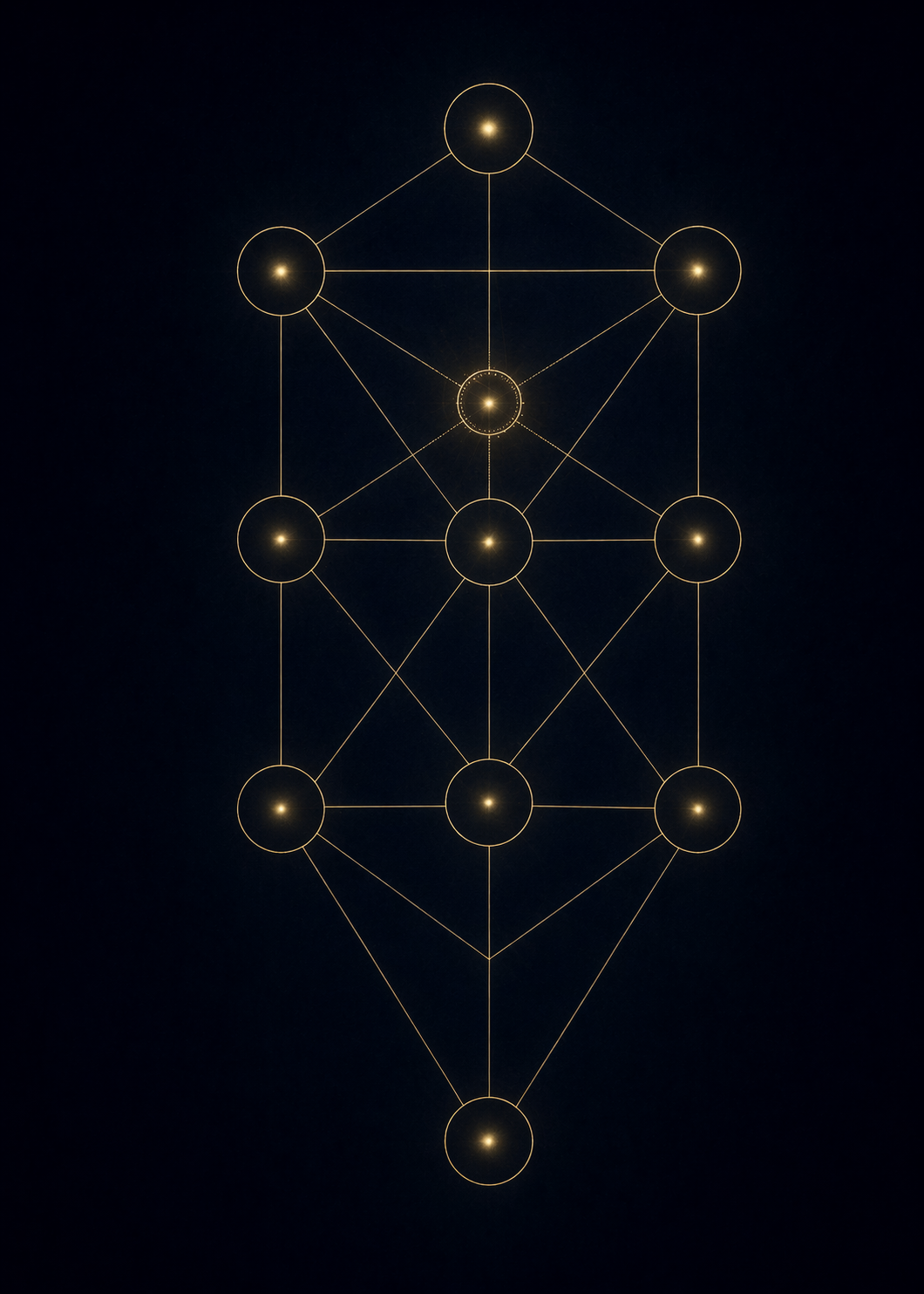
Every serious path of inner development faces the same fork. One direction promises mastery through structure. The other promises transcendence through surrender. Both claim to lead somewhere true. Both can become traps.
Western esotericism has often been read through the image of three pillars. This image comes from Kabbalah, more specifically from the Kabbalistic Tree of Life, with Boaz on the left, Jachin on the right, and a middle column between them. I am not using that structure here as a proved historical law. I am using it as a diagnostic map, a way to read recurring tendencies in Western esotericism and in the psyche that is drawn to it.
The left pillar points toward hierarchy, discipline, and the management of material reality. Freemasonry is one strong historical expression of that tendency, but not the only one. It takes the structure of the world as its starting point and asks how a person can become sovereign within it. Its strength is competence. Its risk is cold control, the reduction of living relation to mechanism.
The right pillar points toward mysticism, surrender, and the dissolution of ego into larger order. Rosicrucian currents are one expression of that tendency, but again not the only one. It takes the yearning for wholeness as its starting point and asks how a person can let go into what is larger than themselves. Its strength is love. Its risk is passive spirituality, the refusal to see clearly because clarity feels like threat.
The middle pillar points toward synthesis. Theosophy is one historical attempt at such a synthesis, and a mixed one. It gathered traditions, renamed some of them, flattened others, and claimed a middle ground that was not always earned. Still, the attempt matters because it names a real problem. What happens when structure and surrender are both necessary, and neither can safely be absolutized.
What the left pillar gets right
The left pillar is not wrong. Hierarchy exists. Material reality has structure. A person who cannot navigate structure will be crushed by it long before they achieve any kind of inner freedom. Discipline, competence, the ability to hold tension without collapsing, these are real skills. The left pillar is grounded in something real, namely that reality is not formless and that power vacuums are quickly filled by whatever is strongest, not whatever is truest.
The problem emerges when the left pillar becomes the whole answer. When structure is all there is, when everything reduces to what can be managed and controlled, then something essential is lost. The person who lives entirely in Boaz becomes a machine that optimizes nothing that matters. They have technique without love, and technique without love is just more sophisticated distortion.
This is where inverse gnosis lives in the left pillar. Intelligence that has learned to manage without ever having to feel, to control without ever having to open. The left pillar offers power, and power is genuinely attractive to anyone who has ever felt powerless.
What the right pillar gets right
The right pillar is also not wrong. There is something larger than the individual self. The pull toward it, toward unity, toward love, toward a plane of being that transcends the small ego, is not delusion. It is real. The yearning that runs through mysticism and alchemy and every serious contemplative tradition points at something that exists. This pillar is grounded in something equally real, namely that structure alone does not explain why life has meaning, why love matters, or why a person can feel called by something greater than utility.
The problem emerges when the right pillar becomes the whole answer. When dissolution is mistaken for wisdom, when surrender becomes avoidance, when the refusal to engage with structure is called spiritual freedom when it is actually fear of the world. This is where false reciprocity lives. Love that will not look, that cannot hold the weight of what is actually there.
The right pillar offers warmth, and warmth is genuinely attractive to anyone who has ever felt cold. But warmth without clarity is just another kind of captivity.
Why the middle path is not a compromise
The middle pillar does not split the difference. It does not take half of Boaz and half of Jachin and call the result balance. That would only be a softer one sidedness.
The middle pillar is synthesis only if both poles are derived from a deeper unity. In Fractalist terms, that unity is the real itself, a world in which structure and openness are both necessary. If reality contains law without reducing to mechanism, and meaning without reducing to sentiment, then any adequate path must be able to honor both. In that sense the middle path is not a third option. It is what becomes necessary once you recognize that each pole is incomplete because each is only one expression of a deeper coherence.
This still has to be earned. A person does not become middle path by naming both poles. They become middle path only when they can hold discipline without becoming hard, and hold warmth without becoming vague. Sobriety that does not collapse into coldness. Love that does not collapse into sentimentality. That is not a mood. It is a practice.
A concrete example helps. Imagine a person formed by the left pillar, competent, exacting, disciplined, confronted by another person’s collapse. Their instinct is to diagnose, organize, solve. A person formed by the right pillar feels the pain, softens, consoles, and risks becoming unable to name what must change. The middle path does something harder. It offers warmth without surrendering structure. It can say I see your pain, and it can also say this pattern cannot continue. It does not choose between honesty and mercy. It binds them together in action.
That is why the middle path is harder than either extreme. It requires that a person become both strong and warm without allowing strength to become hardness or warmth to become weakness. The middle pillar is where the actual work happens because it is where the tension has to be consciously held rather than escaped.
Where Fractalism stands
Fractalism aims at the middle pillar. That is not a throne claim, and it should not be treated as one. Any path that calls itself synthesis is also a contender for authority, and therefore also dangerous. The middle position always risks becoming a grab for the throne dressed as wisdom. It can absorb the names of other traditions, rename their strengths as its own, and quietly assume that seeing both sides makes it superior. That danger has to be named or the claim to synthesis becomes one more form of capture.
The reason Fractalism aims there anyway is that the problem it addresses is distortion. Distortion is not only the result of malice or stupidity. It is also the result of paths that stay too long on one pillar and forget that the other exists. A left pillar path that never confronts its own coldness produces distortion as surely as a right pillar path that never confronts its own sentimentality.
The middle path asks what happens when both are brought to bear on the same problem, with the same honesty. Structure used in service of openness. Love that does not refuse structure. The discipline that holds and the warmth that does not flee. If this produces more clarity, it is not because the middle is automatically true. It is because reality itself punishes one sidedness. The test is practical. Does the synthesis make contact more accurate. Does it reduce distortion. Does it produce outcomes neither pole alone could reliably produce.
This is also where the middle path can fail. It can become intellectual arrogance. It can become a balanced mediocrity that flatters itself for nuance while refusing the severity of either pole. It can feel integrated long before the work of integration has actually been done. The middle path has access to the language of all sides, and that makes self deception easier, not harder.
The risk of the middle path
The middle path has its own risk, which is that it can be claimed without being walked. It also has a deeper risk, which is that it can feel whole before it is whole.
Anyone reading this will likely feel drawn to one pillar and resistant to another. That reaction is not a distraction from the point. It is the point. The three pillars are not only a map of traditions. They are also a projective screen. Some readers will trust discipline and fear surrender. Others will trust love and fear structure. Others again will feel immediately at home in the language of synthesis, and that too is information. The attraction itself reveals where the work is unfinished.
A person who calls themselves middle path while actually staying entirely on one pillar is perhaps the most dangerous figure in the esoteric landscape. They have the language of synthesis, which sounds like wisdom, but they have not done the work of either pole. They are not strong enough to hold structure without becoming hard. They are not warm enough to love without becoming sentimental. They may also be tempted by a subtler illusion, the feeling of being integrated without having tolerated the actual tension between opposites.
That tension is the work. The middle path does not resolve the opposition between Boaz and Jachin. It holds it, and the holding is both the practice and the test. Internally, it feels like refusing premature closure. Externally, it is tested by results. Does the person become more honest, more exact, more compassionate, and less available to distortion. If not, then the middle path is only being named.
Author’s note: Beware of the “trap of abstraction.” A complex intellectual map can be used to mask the absence of practical integration. True synthesis is not found in the understanding of the pillars, but in the painful work of holding the tension between them in real life. If this framework makes you feel superior or ‘integrated’ without causing you actual, physical friction in your daily choices, you are not practicing Fractalism. You are merely consuming a high-resolution simulation of it.
This is where the three pillars are useful as a diagnostic tool. Not to sort people into categories, but to see where any given path, including one’s own, has become one sided. A path that cannot recognize its own one sidedness has already left the middle.
The middle path is always a practice, never a position. That is its nature and its difficulty.
If you want to continue from here, When Both Side Pillars Are Compromised, Only the Middle Remains extends this exact argument into the moment when both horizontal poles become unreliable. After that, When Depth Becomes Control follows the same question into what happens when intelligence stops serving clarity and begins serving capture instead.
Link to this page
https://fractalisme.nl/the-three-pillars-of-western-esotericism